
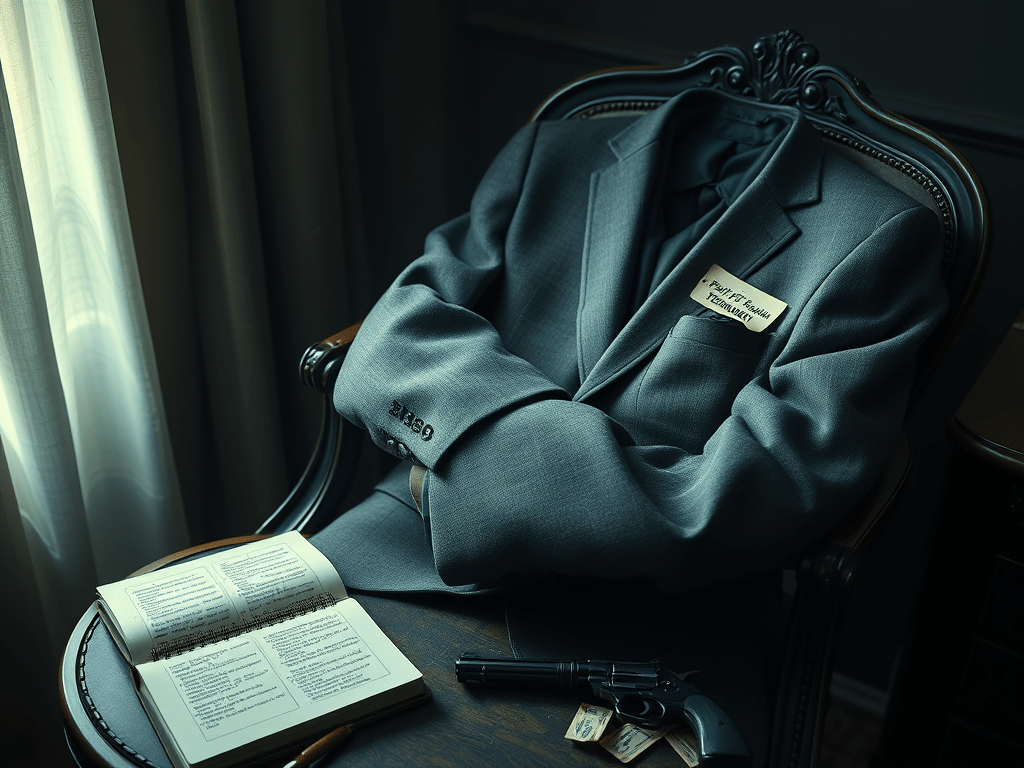
The suit arrived without a body.
It was folded neatly on the chair in my room at the Dominion Hotel, sleeves crossed like an attentive clerk. Grey flannel, narrow cut, the kind of thing that once passed for authority. It smelled faintly of ink, tobacco, and disinfectant. A tag hung from the inside breast pocket, handwritten, no logo.
PROPERTY OF W. S. BURROUGHS (TEMPORARY)
I don’t remember ordering it. I remember little from the night before either, just fragments: a bar with no windows, a man whose face kept slipping out of alignment, a conversation that seemed to happen a paragraph ahead of where we were speaking.
The suit watched me while I dressed.
That sounds paranoid, but paranoia implies an error. This was observation. The fabric had weight in a way that suggested memory, not cloth. When I put my arm through the sleeve, I felt a faint resistance, like the suit was finishing my movement for me.
The mirror confirmed it: I was no longer entirely alone inside myself.
The pockets were full of things I hadn’t put there. A notebook with sentences already crossed out. A revolver that hummed quietly, like an insect trapped in amber. A handful of ticket stubs from places that no longer existed or never had. One read simply: INTERZONE — NO RETURNS.
When I buttoned the jacket, the room rearranged itself.
The walls slid a few inches to the left. The clock stuttered, then resumed with a different rhythm. Outside, the city coughed up a new street name. Language loosened its grip. I understood suddenly that the suit was a device — not a costume but a function.
Burroughs’ suit did not disguise you.
It edited you.
Words began to arrive before I decided to think them. Thoughts appeared already annotated. Every impulse came with footnotes, alternatives, deletions. I tried to say my own name and felt it cross itself out halfway through.
Downstairs, the lobby was full of men wearing identical suits, each slightly out of sync. One man’s tie lagged behind his movements. Another’s shadow arrived a second too early. They nodded to me, not in greeting but in recognition, like editors acknowledging a draft.
“Careful,” one of them said, his mouth forming the word careful while his eyes said inevitable. “The suit likes routines.”
“What does it want?” I asked.
He laughed, then stopped abruptly, as if the laughter had been vetoed. “Want is a sentimental category. The suit produces effects. Control systems don’t desire. They iterate.”
We walked out onto the street together, or rather, the street assembled itself around us as we walked. Advertisements rewrote themselves mid-slogan. Police sirens looped without resolving. Somewhere, a typewriter hammered out yesterday’s news with tomorrow’s casualties.
The suit grew heavier the longer I wore it. Not physically — narratively. It began to anticipate me, inserting conclusions before premises, outcomes before actions. Every time I hesitated, it filled the gap.
This, I realised, was the danger.
Not possession.
Efficiency.
At a café that smelled of burnt coffee and obsolete futures, I tried to take the suit off. The buttons refused to acknowledge my fingers. The fabric tightened gently, the way institutions do when they notice resistance.
A woman at the next table leaned over. She wore no suit at all, just a plain coat and an expression I couldn’t parse.
“You can’t remove it by force,” she said. “You have to misread it.”
“How?”
“Badly. Deliberately. Treat it like a sacred text and get everything wrong.”
So I began to misuse it.
I wore the suit to places it wasn’t designed for: playgrounds, derelict chapels, unfinished sentences. I spoke nonsense into microphones. I answered questions nobody asked. I refused to resolve metaphors. I let contradictions stand.
The suit resisted at first, feeding me better lines, cleaner exits, sharper cuts. But I persisted in error. I stuttered. I rambled. I repeated myself. I let meaning fray.
Slowly, the fabric loosened.
On the third day, the pockets emptied themselves. The revolver fell silent. The notebook filled with blank pages. The tag inside the jacket faded until only one word remained:
TEMPORARY
I left the suit on a park bench at dusk. A man without a face sat down beside it almost immediately, smiling as if he’d been waiting his whole life for this exact draft.
Walking away, I felt lighter, less edited. The city snapped back into a slightly worse version of itself. Language behaved. Control reasserted its grammar.
But sometimes when I hesitate before a sentence, I feel a phantom weight on my shoulders. A suggestion. An edit.
And I remember the suit is never destroyed.
Only passed along.
© B. C. Nolan, 2026. All rights reserved.


 English Voodoo
Leave a comment