
File:00722933391 – The Mother
Snow in Urizar did not fall.
It assembled.
Flakes descended in perfect intervals, each one catching the cold-blue light of the towers and holding it, as if illumination itself had been engineered into the crystal. Liverpool North—Urizar’s annex, Urizar’s mouth—was a city trained into quiet. Sound died early here. Footsteps vanished into powder that was neither fully water nor fully weather.
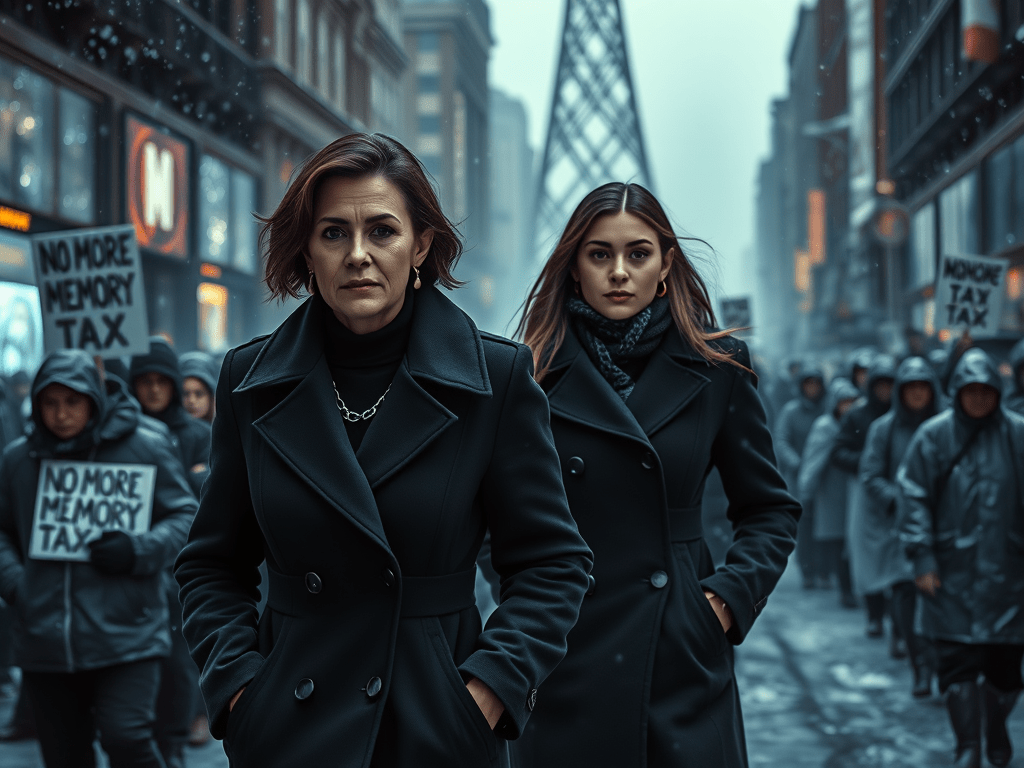
Beyond the cordon, the underclass gathered like a heat-smear against steel. Breath steamed beneath plastic ponchos. Children clung to sleeves and stared upward at the gallery spire—Wyndham Blake’s latest exhibition housed in a repurposed surveillance stack—its windows running vertically like eyelids stitched shut.
A few placards rose above the crowd. Hand-painted. Paint was expensive; the words were small.
NO MORE MEMORY TAX
STOP THE EYE
SOME OF US CAN’T AFFORD TO REMEMBER
The woman arriving did not look at them.
She moved with the unbroken momentum of someone for whom obstacles were curated inconveniences. Her coat was matte black, heated along the seams so snow never clung to it. At her throat hung a fine silver chain, almost invisible until it caught the light: a tiny key, decorative rather than functional.
Her hair was cut to a severe line. Her face held the composed neutrality of those who had paid never to be surprised. Only her eyes betrayed calculation—bright, appraising, always measuring cost and distance.
She was an overclass widow.
The name on her invitation—Merrowe—required no title.
Beside her walked her daughter.
Late teens, perhaps twenty. Slender in a way that suggested precision rather than scarcity. Her coat matched her mother’s but lacked final tailoring, as if she had refused the last adjustment. Her hands were tucked into her sleeves, not from cold but habit. Her gaze moved constantly—left, right, upward—snagging on details her mother never registered.
At the cordon, she slowed.
Not enough to stop. Just enough to notice.
A toddler stared at her—red-nosed, eyes too large for the cold. The girl held the child’s gaze. Something opened in her expression, fragile and unguarded, as if a word were forming.
She glanced instinctively at her mother.
Whatever the word was, it folded away.
A gloved hand touched her elbow.
“Keep moving,” the widow said softly. A kindness delivered as instruction.
The girl nodded. The nod was practiced.
Above them, drones drifted in slow orbits, lenses gleaming with the wet attentiveness of eyes. They hummed in frequencies that soothed the affluent and unsettled the hungry. Urizar’s lullaby: be still, be seen, be known.
A concierge stepped forward from the heated vestibule. Tall, immaculate, his uniform balanced between priestly robe and technician’s coveralls. A small badge on his chest read HOST.
“Mrs Merrowe,” he said, as if presenting an offering. “Welcome. We’re honoured.”
He did not acknowledge the underclass.
“And this is my daughter,” the widow said.
“Miss Merrowe.” The Host inclined his head. “A rare evening to attend. Solstice exhibitions carry particular resonance in Urizar.”
“What does that mean?” the daughter asked.
The Host’s eyes flicked—briefly—to the mother.
“It means,” the widow said, “that it will be memorable.”
Memory, spoken as possession.
The Host smiled wider and ushered them inside.
***
The vestibule swallowed them in warmth. Glass doors sealed with a sound like a sigh. Snow slid cleanly from their coats, pulled away by hidden vents. The air carried pine resin, cinnamon, and something mineral beneath—heated metal, electricity.
Beyond stretched the gallery’s primary corridor: ribbed ceilings vanishing into shadow, walls studded with star-like lights. Guests drifted in slow clusters, overclass couples already holding long-stemmed glasses filled with dark, expensive wine.
Somewhere deeper, music sounded—not melody, but a sustained chord, shifting almost imperceptibly.
The widow walked as if she owned the building.
The daughter walked as if cataloguing evidence.
They passed an installation: two sculpted hands, palms facing, fingers nearly touching, separated by a thin transparent plane. Light shimmered between them, flexing like trapped muscle.
A plaque read:
WYNDHAM BLAKE — THE DISTANCE BETWEEN WITNESS AND MERCY
Interactive. Consent Required.
The daughter slowed.
“Mother.”
“Yes?” The widow turned with patient irritation.
“What is this?” the daughter asked. “Really?”
“A Wyndham Blake exhibition,” the widow replied. “In Urizar. During solstice. It’s fashionable. It’s important.”
“That’s not what I meant.”
“Of course it isn’t.”
***
The Host returned, carrying two slim metallic bands, each fitted with a crystalline node pulsing faintly. Jewellery, until examined too closely.
“Before we begin,” he said, “the interface. This exhibition is neuro-responsive. The Rooms adapt to cognition. It is—”
“Personal,” the widow said.
“Exactly. Stress thresholds are monitored. You may exit at any time.”
“Is it recorded?” the daughter asked.
The Host laughed lightly. “The Rooms are ephemeral. No conscious recordings are retained. Urizar standards are—”
The widow raised her wrist.
The Host clipped the band into place.
The daughter hesitated.
The widow did not look at her. “Don’t be dramatic.”
The girl flushed, then extended her wrist. The band clicked shut. Warmth spread under her skin.
A vibration travelled up her arm.
She shivered. “Is that normal?”
“Synchronisation,” the Host said. “Some find it intimate.”
The widow’s mouth tightened. “Proceed.”
At the corridor’s end, tall white doors waited, seamless, etched with a single unblinking eye.
“The Rooms are sequential,” the Host said. “Past. Present. Future. Some describe it as Dickensian.”
“Dickens is sentimental,” the widow replied.
“And yet,” the Host said, “Urizar finds sentiment useful.”
***
The doors opened.
Room One was white.
Not gallery-white—hospital-white. Merciless. It flattened skin tones, exposed pores, stripped faces of artifice.
At the centre stood a single metal chair. Straps hung loose from its arms.
The daughter recognised it immediately.
Her breath caught.
The widow scoffed. “Subtle.”
The doors sealed behind them.
The wristbands pulsed.
The room shifted.
Not visually. Somatically.
The widow tasted disinfectant. Old carpet. Fear.
Her body remembered before her mind allowed it.
A hand on a doorframe.
A shadow in a hallway.
A presence learning its power.
Her stepfather.
Not as image, but as pattern. As certainty.
Her wrists ached with phantom bruises. Shame rose—old, acidic. Worse than pain was the confusion: affection poisoned into compliance.
She had learned early how to float above it.
The room refused her distance.
Light shifted. Ward-light now. A buzzer sounded somewhere. The chair became a bed.
The hand reached out.
Her jaw clenched.
Then—rupture.
Time jumped.
She was older. Rage had found shape.
Kitchen. Bottle. Laughter.
She stood in the doorway, holding something heavy. The object flickered between forms, as memory does.
The system slowed the moment.
Held it.
Let her examine the calculus.
If he lives, it continues.
If he dies, it ends.
Her younger self was calm.
The blow landed.
Wet. Final.
Relief flooded her—pure, unmediated.
The system did not let her linger.
Ward. Restraints. Diagnoses spoken aloud.
Disturbed.
Affect flattened.
A doctor asked, “Do you feel remorse?”
She stared at the ceiling.
The nurse said, “Poor thing.”
The cruelty of she realised now—ownership disguised as care.
Tears came, unwanted.
She turned——and met her daughter’s gaze.
Not pity.
Not horror.
Understanding.
The daughter watched as one might watch machinery reveal itself.
The wristbands pulsed again.
The memory receded.
The door ahead opened.
The corridor beyond was mirrored glass.
Surveillance clarity.
The widow walked first, rebuilding her composure from habit alone. In reflection, she saw the cracks she had never allowed herself to notice.
Her daughter followed, posture subtly altered. Less deferential. More resolved.
At the corridor’s end, a new symbol waited: a constellation of eyes.
***
ROOM TWO — THE PRESENT
SOCIAL MIRROR. WITNESS REQUIRED.
Behind them, the past sealed itself shut.
Ahead, the present waited—already speaking.
Sound returned before sight.
Laughter—measured, cultured, engineered to suggest pleasure without excess. Conversation layered in careful harmonies. The crystalline clink of glassware. Beneath it all, the low, omnipresent thrum of systems regulating temperature, humidity, affect.
The air felt expensive.
The room resolved as a donor lounge expanded into something grander: a vaulted space lined with translucent panels glowing softly from within. Their surfaces were etched with patterns that read as frost or circuitry depending on the angle. Pale stone tables stretched the length of the room, set with wine and sculpted food—indulgence abstracted, sanitised.
Guests clustered elegantly. Dark clothing. Minimal jewellery. Faces relaxed with the confidence of people accustomed to insulation.
The widow recognised many of them.
Relief flickered. This was familiar ground. Rooms like this were where cruelty softened into charm, where necessity excused harm, where numbers replaced faces.
She straightened, smoothed an invisible crease from her coat, and stepped forward.
No one acknowledged her.
At first she assumed delay—some theatrical pacing. Then she realised: they were speaking freely.
She moved among them—past a woman whose foundation she had financed, past a man whose housing consortium she chaired. Voices flowed unguarded.
“Merrowe’s figures were brutal this quarter,” a man said, wine dark against crystal. “Clean, though. You have to admire the clarity.”
His companion smiled. “Bloodless. Saves the rest of us from pretending we don’t know where the cuts land.”
They laughed.
The widow opened her mouth.
Nothing.
Her jaw moved. Silence.
She tried again. Panic flickered, sharp and unwelcome.
Her wristband pulsed calmly.
She was muted.
“You hear she’s bringing the girl in eventually?” a woman said nearby. “Poor thing.”
“Quiet, though,” another replied. “That can go either way.”
“Better quiet than sentimental,” someone said. “Sentiment ruins margins.”
The widow turned, searching for faces, but the system refused her focus. Features softened, blurred, denying her specificity.
Data began to fall.
At first it drifted lightly—numerals like luminous snow. Then it cohered: graphs, percentages, silhouettes assembling mid-air with elegant precision.
A gesture unfurled a chart: EVICTIONS — Q4. The line rose cleanly.
A laugh summoned grey child-shapes dissolving into statistics.
Her stomach tightened.
This was not how she framed it. She thought in policy. In correction. In abstraction. She believed emotion had been removed.
Here, it had simply been reassigned.
Near the far table, voices carried more clearly.
“Colder than last year,” someone said lightly. “We’ll see a spike.”
“Temporary,” another replied. “The system adapts.”
The widow felt a crack—not guilt, but exposure. A private calculus projected into open space.
She looked for her daughter.
The girl stood at the room’s edge, apart from the clusters. Unlike her mother, she saw faces clearly. Smiles resolved. Eyes sharpened.
“You need someone to absorb the hate,” a young man said. “Merrowe does us a favour.”
“Altruistic, really,” another added. “Someone has to be the villain.”
The daughter flinched.
The widow reached for her—passed through mist.
She was a ghost in her own economy.
The system tightened. Lights dimmed fractionally. Data grew bolder.
Scenes layered over one another—fundraisers, private dinners, closed-door meetings. The widow watched herself smile, nod, dismiss.
They’ll manage.
It isn’t personal.
The market decides.
Faces surfaced: a woman asking for time; a man holding eviction papers rigidly; a child clutching a folder like armour.
The widow’s breath stuttered.
A sharp ripple of laughter cut through the room.
“Did you see her at the council meeting?” a woman said. “Stone-cold.”
“Terrifying,” a man replied. “In a useful way.”
“Trauma as capital,” someone said, almost fondly.
The phrase struck cleanly.
Trauma as capital.
Her past, priced.
The daughter stepped forward.
The room faltered.
“Is this true?” the daughter asked.
Heads turned, uncertain.
“I’m sorry?” a woman said.
“You speak about her,” the daughter said, gesturing vaguely, “as if she’s a function.”
“We’re discussing policy,” the woman replied. “You wouldn’t understand.”
“Try me.”
“This isn’t appropriate.”
“What’s inappropriate,” the daughter said, “is enjoying it.”
Silence spread.
The widow felt fear then—sharp, unfamiliar—not of judgement, but of attention shifting away from her control.
The system recalibrated. Data clustered around the daughter now. Probability curves flickered, unstable.
The widow understood: this room was not only reflecting.
It was measuring.
The daughter turned toward empty space.
“Mother.”
The widow felt it like touch.
“I see you,” the daughter said.
The system reacted.
A discordant tone sounded. Lights flickered. Guests froze mid-gesture, faces locked into polite masks.
The lounge peeled away, dissolving into layered transparency. People reduced to silhouettes, then nodes.
The Host’s voice intruded, strained. “Miss Merrowe, please—this room is calibrated for observation.”
“Not participation?” the daughter asked.
No answer.
The widow felt the pressure at her skull intensify. Fear settled—not panic, but realisation.
Her daughter’s quiet had never been agreement.
It had been attention.
She tried to speak.
“Stop,” she whispered.
The daughter heard her.
The room stilled completely.
“Stop what?” the daughter asked.
“All of this.”
“Why?”
The widow searched for authority, for narrative, for distance.
“Because,” she said finally, “it isn’t fair.”
The daughter laughed once, quietly. “Is that what you think this is?”
The data surged.
In a flash, the widow saw another present: her daughter older, seated at a table like this one, speaking with precise calm.
Her own phrases returned to her.
It isn’t personal.
It’s necessary.
It’s efficient.
“No,” the widow said. “You’re not—”
“You taught me,” the daughter replied. “Just not the parts you wanted to keep.”
The far wall brightened.
A new door resolved, etched with branching lines and embedded eyes.
***
ROOM THREE — THE FUTURE
PREDICTIVE MODEL. OUTCOME PROBABLE.
The widow felt cold spread through her limbs.
She had believed the past was the danger.
The daughter turned toward the door without looking back.
The donor lounge dissolved into drifting data behind them.
The Host’s voice returned, thin and distant. “Please proceed.”
The widow followed her daughter into the cold blue light, understanding at last that the present had already decided too much.
The light in Room Three was colder than anything that had come before.
Not white. Not blue. Something closer to bone seen through ice. It flattened shadow, erased softness, denied comfort. The air felt thinned, optimised, as if excess oxygen had been engineered out.
The widow crossed the threshold and felt pressure bloom behind her eyes, the sensation of standing too near a vast machine already in motion.
The room was circular, vast, its walls curving upward until height dissolved into glow. There were no furnishings, no centrepiece. Only space, light, and calculation.
At the room’s core hovered a slow-rotating lattice of lines and nodes. It resembled a neural map rendered architecturally, or a constellation taught to think. At each junction, a small eye opened and closed, patient and unblinking.
The daughter stopped a few steps inside.
She did not hesitate.
The widow did.
Her body recognised the space before her mind named it. This was not memory. Not commentary. This was projection — the territory she herself traded in.
The wristbands pulsed together.
A low tone vibrated through bone.
IDENTITY CONFIRMED.
The voice was not the Host’s.
It was older than politeness.
PREDICTIVE MODEL INITIATED.
“No,” the widow said, reflexively. “I didn’t consent to—”
She stopped.
She had.
The lattice brightened.
Data assembled with elegant inevitability. Her life appeared not as scenes but as vectors — trajectories arcing backward into compressed origin and forward into diminishing branches.
SUBJECT: MERROWE — PRIMARY
STATUS: STABLE
TRAJECTORY: CONSOLIDATION
Images flickered at the periphery: boardrooms, donor walls, buildings bearing her name. Carefully worded obituaries archived in advance.
She felt the hollow echo of pride. By every measure she trusted, this was success.
The lattice shifted.
A secondary cluster ignited.
SUBJECT: MERROWE — SECONDARY
No name. Just function.
The widow’s breath caught.
Lines extended rapidly, branching, looping, collapsing. The curves were unstable, volatile.
EMOTIONAL SUPPRESSION: ELEVATED
RAGE LATENCY: PROLONGED
CORRECTION EVENT: LIKELY
The daughter stared at the lattice, expression unreadable.
Almost — relieved.
“What is that?” the widow demanded, stepping forward.
The system answered by showing.
The room dimmed at its edges. A scene resolved directly in cognition.
She saw herself older — preserved, not frail. Skin taut with intervention. Movements precise. She moved alone through a high, immaculate space curated to signal taste rather than comfort.
Her daughter stood across from her.
Older. Harder.
They argued. The words dissolved as irrelevant. Outcome mattered more than content.
The daughter’s hand moved.
Pain arrived before comprehension.
The widow looked down and saw blood spreading across her coat, dark and absolute. The daughter stood above her, expression stripped of excess.
Then nothing.
The vision collapsed.
The widow staggered, catching herself. Her heart hammered. Sweat chilled on her skin.
“That isn’t inevitable,” she said. The words sounded thin.
PROBABILITY: 87.6%.
She laughed once — brittle. “You’re wrong. I don’t lose control.”
The lattice pulsed.
ALTERNATE PATHWAYS AVAILABLE.
INTERVENTION REQUIRED.
Relief surged, desperate and immediate.
“Then show me,” she said. “Show me how.”
The daughter turned toward her.
For the first time, something like curiosity surfaced.
The lattice reconfigured.
The room shifted again.
This time, the widow was not the victim.
She saw a gallery reception. Wine in her hand. Her daughter across the room — distracted, vulnerable in a way she had never acknowledged.
The thought formed cleanly:
Remove the risk.
The moment slowed.
The same suspended second she had seen before. The same internal stillness.
If she lives, it continues.
If she dies, it ends.
The glass rose.
The reflection of her own face curved within it — focused, resolved.
The strike.
Crystal shattered.
Blood on white floor.
Her daughter falling.
The widow screamed.
The vision severed instantly.
Silence rushed in.
The lattice dimmed. Eyes closed one by one.
The widow dropped to her knees. Her breath tore at her chest. No words came — only soundless denial.
The wristbands cooled.
The pressure lifted.
A door slid open behind them.
She raised her head slowly.
The gallery had returned.
Guests murmured appreciatively. Music resumed. Snowlight filtered through tall windows. Someone clapped — mistaking conclusion for performance.
Her daughter stood nearby.
Alive.
Uninjured.
Watching.
The widow surged to her feet, reaching instinctively.
“Don’t,” the daughter said.
The word stopped her.
The daughter’s eyes were clear now. Not angry. Not afraid.
Certain.
“You saw it too,” the daughter said.
The widow nodded, tears uncontained.
“I would never—”
“You already have,” the daughter replied gently.
Silence stretched.
The Host approached, smile restored, eyes empty.
“Thank you for attending,” he said. “We hope the experience was illuminating.”
The widow barely heard him.
“What happens now?” she asked.
The daughter considered this.
“I don’t know,” she said. “That’s the first thing you’ve ever shown me that I believe.”
They walked toward the exit without touching.
Outside, snow assembled itself in perfect silence. Surveillance lights fractured through each falling crystal.
As the city’s gaze settled over her, the widow understood the truth Urizar never bothered to hide.
It did not punish.
It remembered.
And it waited.
TBC 22/12/2025
© B. C. Nolan, 2025. All rights reserved.
 English Voodoo
Leave a comment