
The shuttle hissed open with a sigh like something exhaling through damp lungs.
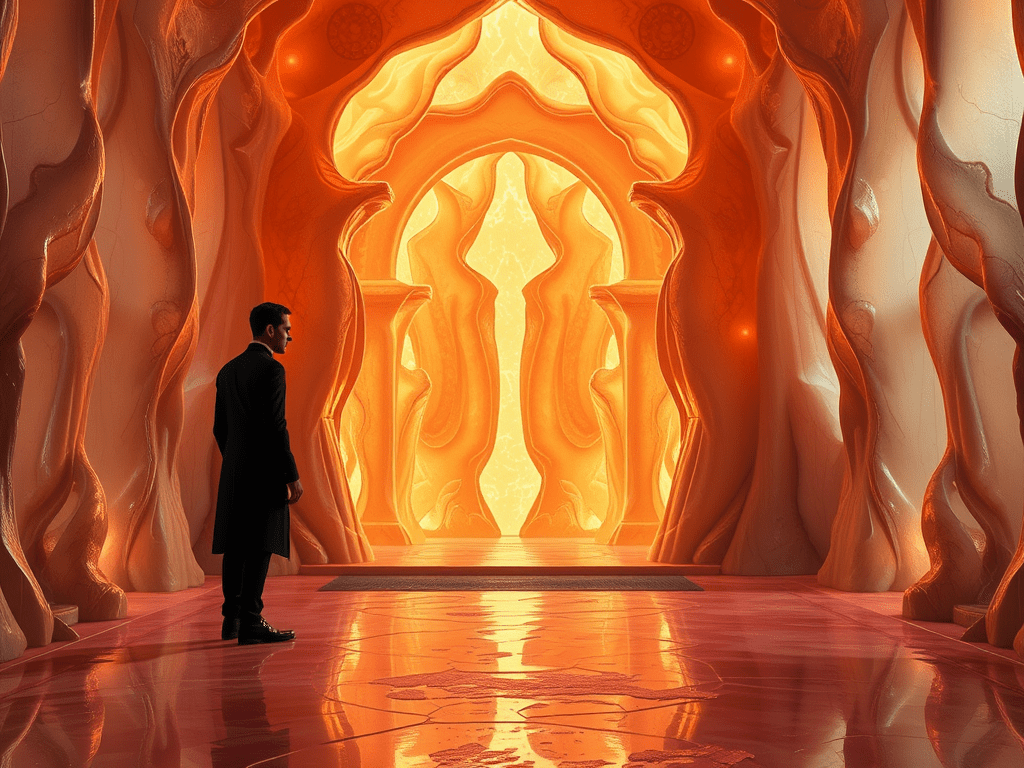
Heat slid over Mara Vex’s skin as she stepped onto the rose-gold concourse. The air shimmered faintly; it smelled of copper, lilies, and rain.
Before her, the Tharna Art Nexus rose from the crimson fog — a cathedral grown rather than built. Its surface glowed with a wet sheen, fibrous and pulsing. Capillaries of light travelled beneath translucent walls, a network of living illumination. The structure seemed to breathe, slowly and steadily, as though every visitor entered a patient organism.
Oren Hale waited by the entrance, immaculate in a black suit with a thin membrane collar that seemed to drink the light. His expression was patient, almost priestly.
“Miss Vex,” he said, voice like oiled glass. “You made excellent time. The engines are seldom cooperative this far south.”
Mara brushed condensation from her gloves. “They respond to money. Like everything else.”
A faint smile. “Indeed.”
He gestured toward the doorway, a wide organic aperture that dilated as they approached. “Welcome to The Flesh Cathedral. Wyndham Blake’s latest and—perhaps—final exhibition.”
The floor underfoot was warm and faintly pliant. Each step left a shallow impression that closed again, soundlessly. The entrance sealed behind them with a subtle shudder.
Inside: silence, dense and intimate. The gallery’s interior glowed with a diffused blush, the walls almost translucent. Threads of light pulsed within them, like veins under skin. Deep within the structure, a low heartbeat echoed — not mechanical, not entirely natural.
“It’s humid,” Mara observed. Her voice sounded oddly close, absorbed by the air.
“It helps preserve the material,” said Oren, guiding her down a corridor lined with slow-moving patterns, the surface shifting like a living fresco.
“The material?”
“You’ll see.” He inclined his head, tone utterly casual. “Blake always believed art should breathe. That we should not simply look upon it, but be looked upon in turn.”
She gave a dry laugh. “He’s been saying that since his Venice years. I suppose now he’s finally liberalised it.”
They passed through a translucent membrane that quivered as they moved through, leaving moisture on Mara’s cheek. Beyond it, the first exhibition hall waited — soft light, immaculate geometry, the scent of antiseptic and roses.
Oren stopped at the threshold. “Before we begin,” he said, “you should know this: everything you see here was made in accordance with Blake’s final principle.”
“And what principle is that?”
“That ownership and devotion are the same act,” Oren said, eyes glinting faintly. “One consumes the other.”
Mara smiled — thin, unamused. “Then I’m in the right place.”
He opened the inner door with a motion that felt ceremonial. The room pulsed once, like a held breath released.
“Welcome,” he said softly, “to Agape Constructs.”
***
The first gallery was almost tranquil in its horror.
Soft light emanated from panels veined like marble, though the veins pulsed faintly, a warm rose hue migrating slowly beneath the surface. The air carried the scent of salt, old flowers, and something faintly sweet — like skin heated by touch.
Rows of objects stood beneath spotlights, each one surrounded by a low hum. Furniture at a glance: tables, chairs, benches. Their shapes were classical, familiar — until the eye lingered too long.
The chaise nearest the entrance was upholstered in something neither leather nor fabric. It had pores. The edges gleamed slightly with moisture. Threads of gold wiring traced its seams like surgical sutures.
“This collection,” Oren said, his tone as placid as a museum guide’s, “explores the ergonomics of surrender. Each piece invites contact — the human form sculpted by the function it once performed.”
Mara Vex circled the chaise. Its surface shivered as her shadow passed over it. She paused, assessing. “He’s abandoned abstraction,” she noted. “Finally stopped pretending to be subtle.”
Oren smiled faintly. “Blake believed subtlety was a symptom of fear. He’s grown fearless.”
Her heels clicked softly on the pliant floor. She stopped before a writing desk — sleek, symmetrical, its surface patterned with intricate ridges. At first, they looked like ornamental inlays. Then she realised they were veins, flattened and preserved beneath a glass-like membrane.
“Incredible craftsmanship,” she murmured, running her gloved hand along the edge. It was warm to the touch. “His realism’s improved.”
“He’s dispensed with imitation entirely.”
She looked up. Oren’s eyes were steady, unblinking.
A low vibration ran through the desk — rhythmic, almost like breath. Mara withdrew her hand.
Beyond it, a pair of chairs sat together, backs arched in perfect symmetry. Their supports were carved from something pale, almost bone-like, though far too detailed. The contours of human ribs shaped the frame, hands forming the armrests, fingers curved elegantly downward.
Oren tilted his head toward them. “The ‘Companions.’ Designed to encourage dialogue between equals. See how the hands cradle rather than restrain?”
Mara studied the fingers. There were nails, faintly translucent, perfectly manicured. She stepped closer, expecting resin or a synthetic polymer. There was none of the telltale grain.
Her voice lowered. “He must’ve used biological replication tech for this texture. It’s too perfect.”
Oren’s smile deepened by a fraction. “Perfection,” he said, “is seldom artificial.”
For a moment, only the hum of the gallery filled the silence. It wasn’t constant — it had a pulse, a rhythm that seemed to follow her heartbeat.
Mara turned sharply toward the next exhibit, eager to dismiss the creeping unease. A coffee table stood under a halo of soft light, its top a translucent panel. Beneath the surface, a faint silhouette moved — too slow for machinery.
She exhaled. “And this one?”
Oren stepped beside her. “A meditation on transparency. The artist believed that devotion hides beneath all civility. One must look beneath the surface.”
Mara stared harder. The thing beneath the glass was shaped like a torso, the faintest rise and fall visible through the haze. She blinked — and it was still again.
“Motion sensor illusion,” she said briskly.
“Of course,” Oren agreed. His tone did not change.
They moved on, their reflections rippling across the pale walls. The further they walked, the thicker the air seemed to become — viscous, humming softly in the throat.
When they reached the far door, Oren paused with a faint bow.
“The next chamber,” he said, “requires a different kind of seeing. Blake called it his ‘mirror room.’ Few visitors linger long.”
Mara smiled, though her lips felt dry. “Good. I never linger anywhere.”
The door ahead dilated with a moist sigh, and from beyond came a faint rhythmic thumping — slow, deep, and human.
Oren extended his hand. “After you, Miss Vex.”
***
The door closed behind them like a throat sealing.
Light dimmed to a submerged glow — pearlescent, tidal. The air was close, humming faintly with pressure. Every sound — her breathing, the soft click of her shoes — came back doubled, as though the room itself listened.
Mara Vex stood still, letting her eyes adjust. The space was circular, its walls mirrored in panels that curved overhead into a dome. Her reflection surrounded her — multiplied, warped — a hundred versions of herself watching from every angle.
In the room’s centre waited a table.
It was round, translucent, luminous from within. Something like mist or smoke moved slowly beneath its surface. The surrounding chairs were sculptural — fleshy forms shaped to the human body, pale and supple, with a soft gleam across their contours.
Oren Hale moved like a shadow through the reflections. “This installation,” he said quietly, “is titled Self as Material. Blake believed that the boundary between observer and object was the final illusion. Here, he invites you to dissolve it.”
Mara circled the table, arms crossed. “A little heavy-handed, don’t you think? Even for him.”
“Perhaps. But the work demands participation. Sit, if you would.”
She hesitated, scanning the chair nearest to her. The seat was faintly warm, as though someone had just risen from it. Too late to withdraw gracefully — she sat.
The chair adjusted.
It shifted under her, soft as breath, moulding itself to her shape. A faint hiss of air — or suction — passed through the seams.
“Interactive art now?” she said, half amused, half uneasy.
“Responsive,” Oren corrected. “Blake wanted the work to acknowledge presence. To show gratitude.”
“Gratitude?”
“He said Every act of attention feeds creation. He designed these pieces to remember.”
Mara leaned back. “Remember?”
“Yes,” Oren said, and his reflection — or one of them — smiled behind her shoulder.
Something pulsed beneath the table. Slow, deep, organic. She leaned forward, peering through the glassy surface. For a moment she thought she saw light — bioluminescent veins forming shapes. Then, unmistakably, fingers.
She blinked hard. The forms were gone. Only the faint mist remained.
Oren’s reflection multiplied endlessly around her, faces repeating like icons in a cathedral dome.
Each one watched her.
Each one seemed to be smiling just a fraction wider than the real man.
A whisper — too low to be words — rose from beneath the table. A susurrus of breath, perhaps air moving through vents, perhaps something else. It came in time with her heartbeat.
“What is that sound?” she asked, her voice hushed despite herself.
Oren tilted his head. “Resonance. The table aligns with the visitor’s pulse. A conversation between rhythms.”
Her throat felt dry. “Feels… invasive.”
“All communion is.”
Mara stood abruptly. The chair clung to her for a moment before releasing, with a faint wet sound.
She smoothed her skirt. “Clever trick. He’s always been a sadist with budget.”
Oren smiled politely. “Sadism,” he said, “is only intimacy without consent. Here, the audience offers itself freely.”
Her reflection — hundreds of her — shifted slightly as though the mirrored walls had moved in closer. She felt a twinge in her chest, a pressure she couldn’t place.
She turned toward the exit. “Show me the next one.”
Oren’s eyes gleamed faintly in the soft light. “Of course,” he said. “The next installation is called Devotion Engines. Blake considered it the culmination of the entire series.”
The doorway opened ahead of them, glowing with deeper rose light, the hum louder now — like the pulse of something vast and living behind the walls.
Mara hesitated, glancing once more at her reflections. For an instant, one of them did not move with her.
Then she stepped forward, heels sinking slightly into the living floor, as Oren Hale followed in silence.
***
The next chamber opened like a wound.
Warm air rolled out, heavy with incense, iron, and the faint sweetness of decay. The lighting deepened into tones of rose and amber, refracted through translucent walls that throbbed faintly as if lit by the pulse of a heart too vast to see.
Mara Vex paused on the threshold. “Smells like a chapel,” she murmured. “Or a slaughterhouse.”
“In Tharna,” Oren replied, “there’s rarely much difference.”
The space was cavernous — arched like a cathedral nave. Along each side, colossal forms rose from the floor: tables, thrones, altars — but all breathing, all faintly alive. Tubes of soft tissue pulsed within the walls, pumping a glowing fluid that cast the room in an unsteady, holy light.
At the centre stood a banquet table, vast and radiant. Plates made of vertebrae, goblets carved from skull-like forms, candles dripping golden fat down living spines that arched as candelabra. The table’s surface quivered now and then, a shallow tremor, as though dreaming.
Mara stepped closer despite herself. The table emitted a low sound, something between a hum and a moan.
“This is…” she started, unable to finish.
Oren’s voice was calm, reverent. “Blake called them Devotion Engines. He wanted to test the hypothesis that love, properly distilled, can power anything. A society. A machine. Even a god.”
She traced a gloved finger across the table’s gleaming surface. It was warm again, warmer than before. Beneath the translucent layer, she could swear she saw faces — sleeping, serene — arranged in symmetrical patterns.
“These aren’t prints, are they?” she asked.
“No,” Oren said. “Blake found prints limiting. He preferred collaboration.”
The word lingered, ambiguous, oily.
As she moved along the table, her reflection distorted in the amber light. The goblets seemed to tilt slightly toward her, as if eager. The candles’ flames elongated, shimmering unnaturally.
“What’s inside the walls?” She asked, hearing her own voice falter.
“Circulation,” Oren said simply. “All living things require flow.”
“Living things,” she repeated, pivoting to face him. “You mean—”
He inclined his head. “Organic integration. Nothing wasted. Each volunteer is part of something greater. Their devotion is literalised.”
“Volunteers?”
“Blake never forced participation. He only invited it. Some were his admirers. Some, his collectors.”
The hum thickened in the air, a pressure behind her eyes. She realised the table’s pulse was synchronising with her own heartbeat again.
“Sounds like a cult,” she said, forcing a laugh.
Oren’s eyes flicked toward her. “And the market is not?”
The walls flushed slightly darker, a ripple of crimson moving through them. The spines of the candelabra twitched, subtle but unmistakable.
Mara took a step back, her heel sinking slightly into the living floor. “Enough. I’ve seen what I came for. Send me the acquisition list tomorrow.”
“I’m afraid Blake’s final piece cannot be purchased,” Oren said. “It can only be received.”
He gestured toward the far end of the hall. A single pedestal waited there, draped in a white veil that glowed faintly from beneath.
Mara hesitated. “What’s under that?”
“The conclusion,” Oren said. “His magnum opus. The Chair of the Collector.”
Something in his tone — not menace, exactly, but a serene inevitability — tightened her gut.
She walked toward it anyway.
Behind her, the Devotion Engines whispered softly, like a hundred voices murmuring prayers underwater. The air vibrated with quiet ecstasy, and from somewhere deep within the walls, a sigh of pleasure — unmistakably human — rippled through the cathedral.
Oren followed, his footsteps inaudible.
“Blake always admired you,” he said conversationally. “Your acquisitions, your taste, your willingness to possess without sentiment. He said You embodied the market’s purity.”
“I’m flattered,” she said, but her voice trembled now.
“He left this piece unfinished,” Oren continued. “Said he needed the right… participant.”
She stopped before the veiled shape. It was unmistakably a chair, human-shaped in its curvature, the outline almost feminine.
Oren’s voice lowered to a murmur. “He designed it for a single viewer. One who understood that beauty must be owned — utterly.”
Her hand hovered near the veil. The glow beneath it pulsed once, in rhythm with her pulse.
“Would you like to see it?” Oren asked.
Mara hesitated, then nodded.
Oren smiled gently. “Then look.”
Oren Hale reached for the veil as though unveiling a relic.
The fabric clung to his fingers with a faint, wet sound, then slipped free.
Beneath it stood a chair that was more human than object.
The frame was sculpted from bone-white arcs that gleamed faintly beneath the rose light. Its back was curved like a spine; its armrests were pale and smooth, ending in delicate hands that seemed almost to breathe.
But it was the face that stopped her.
Her own.
Perfectly rendered — serene, eyes closed, lips slightly parted as if in prayer.
Mara Vex stared. “How…” Her throat closed around the word.
Oren’s expression was tranquil. “Blake worked from resonance, not reference. He said, the subject will reveal herself in time.”
“I never sat for him.”
“Not consciously.”
She took a step backward. The floor pulsed beneath her heel, softening. “You can’t possibly expect me to believe—”
Oren tilted his head. “Belief isn’t required. Only participation.”
The lights dimmed slightly. The air grew heavier. The hum in the walls deepened to a pulse she could feel in her chest.
“I think we’re finished here,” she said sharply. “Send me your proposal tomorrow. I’ll have my assistant—”
“Your assistant has already been notified.”
Her breath hitched. “Notified of what?”
“That your patronage has been accepted.”
The hum intensified, and suddenly she could feel the room moving — subtle contractions beneath the floor, like muscle. The mirrored panels along the walls rippled, distorting her reflection until her many selves twisted into grotesque symmetries.
“What is this?”
“The transaction,” Oren said. “You desired to own something truly unique. Blake’s final gift ensures that ownership becomes indistinguishable from sacrifice.”
She turned to run, but the floor seized her feet — warm, pliant, clinging. A surge of panic cut through her chest as she pulled, but the surface only tightened, rising around her ankles like flesh knitting itself together.
“Oren!”
He regarded her calmly. “You misunderstand your role, Miss Vex. The collector and the collected are two halves of the same prayer.”
The walls flushed crimson. The heartbeat in the room grew thunderous.
The chair — her chair — began to breathe. Slow, deliberate inhalations. Its face — her face — opened its eyes. They were glassy, milk-white, but they moved, focusing on her.
A voice, faint and layered, slipped from the air. It was her own voice, echoing back at her:
“Ownership… and devotion… are the same act.”
She screamed. The sound was swallowed instantly by the walls.
The floor surged upward, enveloping her legs, her hips, warm as living skin. Tendrils of light coiled from the walls, wrapping around her arms, her throat. She fought, nails digging into the pulsing surface, but it was like clawing through muscle.
Oren stepped closer, face illuminated by the holy glow. “Do not struggle. The work requires stillness.”
“Let me go!”
He smiled. “It already has.”
The tendrils lifted her gently, almost reverently, into the chair’s embrace. The arms of the sculpture unfolded, welcoming her. The faces in the walls began to chant — a low, rhythmic whisper that merged with the heartbeat.
Her body sank, her skin fusing seamlessly with the chair’s surface. The pulse of the structure synchronised with her own, then overtook it.
Her last breath escaped as a sigh, soft, indistinguishable from the air itself.
Oren watched the transformation complete — the chair gleaming anew, its form subtly altered, its expression faintly smiling now. The walls quieted. The heartbeat steadied.
He straightened his jacket, exhaled once, and turned toward the door.
“Perfect balance,” he murmured. “An equilibrium of giving and taking. Blake would be pleased.”
The chair’s eyes closed again, serene in eternal repose.
As Oren walked away, the faintest sound followed him — a single heartbeat, steady and alone, echoing through the Flesh Cathedral.
***
Dawn never touched Tharna. The sky above the city was a perpetual blush of rose and gold, like light filtered through skin.
By evening, the Art Nexus had come alive again — the hum replaced by music, the silence by laughter wrapped in money. The air smelled of champagne, pheromones, and antiseptic. Drones hovered above the entrance, streaming the opening night to a waiting world that fed on spectacle.
Inside the Flesh Cathedral, everything gleamed with impossible polish.
The humidity had been tempered for comfort; the heartbeats reduced to a gentle, almost pleasant rhythm.
Oren Hale moved through the crowd like a curator at communion, his black suit immaculate, his eyes soft with professional serenity.
Critics, collectors, and ambassadors floated between the exhibits, their glasses of golden liquor reflecting the gallery’s gentle pulse.
The Devotion Engines glowed under the lights. The tables and chairs seemed quieter now, subdued — only the faintest movements betraying their vitality. The guests assumed it was clever simulation, an algorithm for realism.
They adored it.
“It’s Blake’s most mature work,” said one critic. “He’s moved past provocation. This feels… devotional.”
“A revelation of material,” murmured another. “It makes suffering beautiful again.”
A billionaire in bioplastic couture raised her glass. “I’d give anything to own one.”
Oren’s smile was soft and slow. “Ownership is always possible. For those willing to give enough.”
They laughed — assuming it was a joke.
He led them toward the central hall, where the Chair of the Collector awaited its unveiling. The guests gathered, breathless and expectant, as the spotlight descended like a benediction.
The chair gleamed pale in the glow — its surface flawless, the skin smooth, the expression serene. The face — her face — was sculpted into an eternal calm. Eyes closed. A faint smile at the corners of the mouth.
The crowd gasped.
“It’s uncanny,” someone whispered. “Almost alive.”
“It even seems to breathe,” said another, stepping closer. “How does it do that?”
Oren’s voice was soft, reverent. “All true art breathes. The artist simply had the courage to acknowledge it.”
They applauded. Cameras flashed. The live-feed broadcasted the masterpiece to millions — who saw only art, never agony.
As the guests toasted to genius and transcendence, the Flesh Cathedral responded — a subtle tightening in its walls, a deep sigh of satisfaction that no one noticed.
For a moment, the soft hum of the building aligned perfectly with the rhythm of the guests’ hearts, binding them into one living pulse.
Oren Hale stood quietly beside the chair, gazing at it with something close to affection. He raised his glass slightly, as though offering a private salute.
“To devotion,” he murmured.
The chair’s lips moved — just barely — shaping the same words back.
The hum deepened.
The lights flickered, then steadied.
The applause rose again, filling the cathedral like prayer.
Outside, Tharna pulsed on — a city built on warmth, blood, and beauty — unaware that beneath its shining surface, the art had begun to grow.
© B.C. Nolan, 2025. All rights reserved.
 English Voodoo
Leave a comment