
The train slid across the spine of Voragon like a silver needle stitching through glass.
It cut between megastructures, slicing through haze, light, and memory. The windows tinted and dimmed as they entered a new sector — Sector 9 — the line tightening; the hum deepening.
Inside everything was soft, deliberate, sterilised. A gentle synthetic lavender lingered in the filtered air. The seats reclined automatically when someone sighed. The lights warmed themselves to the mood of the passengers, adjusting to comfort rather than clarity.
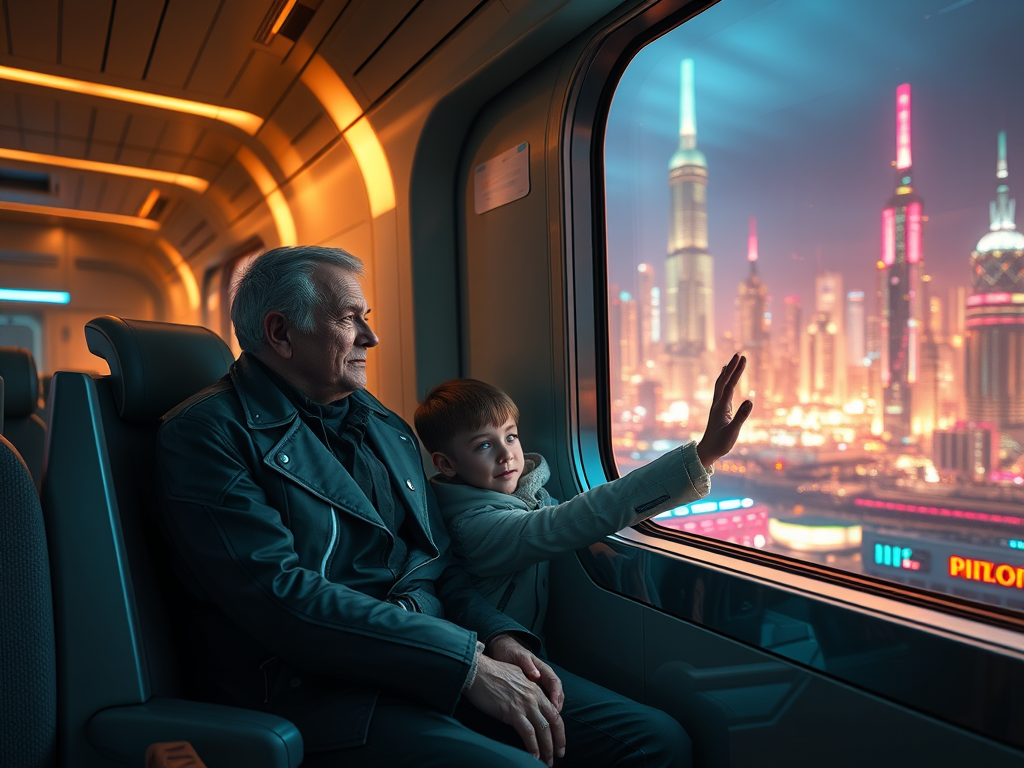
A boy and his father sat by the window, the city reflected in their faces.
The boy pressed a hand to the glass, feeling the vibrations run through his fingers.
“Listen,” the father said, without looking at him. “That sound — that rhythm. The tracks soothe the mind if you let them.”
The boy tilted his head. Beneath the hum of the turbine, there was a steady clack-clack, a hypnotic pulse. He tried to match his breathing to it. The world beyond was a smear of lights — blues, pinks, and toxic greens bleeding together into streaks.
Then came a thud.
The boy flinched. “What was that?”
The father didn’t even blink. “Animals,” he said. “They wander onto the rails sometimes. The city’s full of strays. Rats, dogs, people. Doesn’t matter which.”
Another bump. Then another. A faint tremor ran through the floor.
The passengers didn’t react. They were a catalogue of eccentric wealth: suits woven with luminescent thread, polished chrome implants, whisper-thin spectacles that projected invisible data. A woman in a coral overcoat sipped from a silver bulb of narcotic vapor. An old man with jewelled hands scrolled through news of markets collapsing and reforming.
No one looked up.
The boy swallowed. “Do they—”
“Die?” the father said, finishing his thought. He smiled faintly. “Yes. But that’s alright. They’re pests. It’s good for the city to keep the numbers down.”
He leaned closer, his voice suddenly warm — too warm.
“I love those bumps most of all. Each one means the system is working.”
The boy stared at him, trying to understand. The father’s eyes were pale, reflective, the iris ringed with data-glow. He looked like he belonged to the train itself.
Outside, towers rose like tombstones. Old billboards flickered between propaganda and prayer:
“OBEDIENCE IS SANCTUARY.”
“WASTE NOT THE BODY — SERVE THE GRID.”
“VORGONA FEEDS THE WORLD.”
Between the towers were dark fields of habitation blocks — tens of thousands of lives folded into vertical grids. No light but the artificial blue of the city core.
Then, in the distance, through the streaked window, the boy saw movement — a figure running toward the rails.
A woman.
She was waving her arms, mouth open in a soundless plea.
The boy’s breath hitched. “Dad, she’s—”
His father chuckled softly. “Looks like she missed her stop.”
The woman disappeared beneath them in a flash of white light and motion blur.
The bump came a second later, heavier than before. The boy thought he had heard something splinter.
“Was she—”
His father sighed, as if tired of the question. “It’s all part of the cycle. Everything has value in Vorgona. Even the ones who throw themselves away.”
The train continued on; the hum deepening.Outside the sectors shifted from residential ruin to industrial sprawl. Rows of turbines lined the horizon, spinning faintly in the smog. Each one glowed with an inner, pulsing light—Agape cores, the ads called them. Biomass reactors powered by what the government termed “Reintegrated Human Material.”
The boy had seen the documentaries: smiling engineers, diagrams of circular sustainability, citizens volunteering to become “useful again.” It had seemed noble when shown on the holos — clean, efficient, painless. But now, staring at the streak of red drying across the window, he wasn’t so sure.
The train slowed as it neared a transfer station. The PA system chimed in a calm female voice:
“Next stop: Zenith Station. Please remain seated during harvesting procedures.”
The father straightened his tie. “Watch carefully,” he said. “It’s important you understand how things work.”
The boy pressed his face against the glass.
On the platform ahead, dozens of people stood in a single line. All motionless. They weren’t passengers—their clothes were too thin, too ragged. They stared straight ahead as the train approached. Some wept silently; others smiled faintly, as if in relief.
The boy frowned. “Who are they?”
“Volunteers,” his father said. “The ones who signed the Final Compact. Nothing left for them above ground. This way, they serve the system. Feed the grid.”
The train’s turbine array opened like a mouth — a vast steel aperture rimmed with energy blades, rotating faster, faster. A low, inhuman whine filled the carriage.
Then, the first man stepped forward.
He didn’t hesitate.
He simply walked into the oncoming light.
The others followed, one by one, until the air outside was filled with the blur of motion and the dull percussion of impacts—thump, thump, thump. Some bodies were caught whole by the turbine, vanishing instantly into the processing unit; others bounced away, breaking apart against the platform edge. The array’s glow deepened to crimson.
The boy could taste iron on his tongue.
He turned toward his father in horror. “Why do they jump?”
For a long moment, the father said nothing. Then he looked at his son with something almost like pity.
“They have nothing else to live for.
He smiled thinly.
“But they’re not wasted. Vorgona wastes nothing. Their sacrifice keeps the lights on. Keeps us moving.”
The boy turned back to the window. His reflection shimmered against the dark — pale face, wide eyes, city lights carving lines across his skin.
The surrounding passengers applauded politely as the turbine doors sealed and the PA voice announced:
“Harvest complete. Thank you for your patience. Enjoy your journey through the Eternal Circuit.”
The train lurched forward. The hum returned, smooth and steady.
The father closed his eyes, content. “There,” he murmured. “Back to the soothing rhythm.”
Outside, the night unfolded again—endless, electric, and indifferent. The towers of Voragon glittered like gods watching themselves in mirrored glass.
The boy tried to listen for the rhythm his father loved so much. But all he could hear now were the bumps.
Each one a heartbeat.
Each one a life.
***
Years later, the boy sits by the same window.
Now grown, his suit immaculate, his hands resting neatly on his knees.
The hum of the train surrounds him like a cradle.
Beside him, his own son peers out into the smog, wide-eyed, pressing small fingers against the glass.
The father smiles faintly, eyes glowing with the same pale data-ring as his own father once had.
“Listen,” he says softly. “That sound—the rhythm of the tracks. Soothing, isn’t it?”
Outside, the turbines spin.
Inside, the train glides.
And the system keeps sliding forward.
© B.C. Nolan, 2025. All rights reserved.
 English Voodoo
Leave a comment