
Out of Time
Rain was falling in slow, electric curtains — each drop catching the light of the city and splitting it into spectrums that never should’ve existed. Vorgona’s sky had been dead for years, but it still glowed from the static haze of the turbines.
Corvin Hale pulled his coat tighter and kept walking. His shoes splashed through puddles that mirrored nothing. Every clock in the city seemed to tick in a different rhythm tonight. Some fast. Some slow. None in time with his pulse.
He knew he was being followed long before they showed themselves. You didn’t survive long in Vorgona without learning how to feel eyes on your back. Still, he didn’t run. Running was for people who thought time still belonged to them.
A shadow detached itself from a doorway — then another, and another. Three of them. The same kind of street muscle the Meridian Syndicate liked to use: cheap synthbone grafts, borrowed tempers. The leader was a tall slab of a man with mirrored eyes and a voice that came out like static through a bad speaker.
“Corvin Hale,” the voice rasped. “Clock says you’re out of time.”
Corvin tried to keep his tone steady. “Tell your boss I’ve got something coming in. A job. I just need a few more days.”
The big one smiled — or at least made the motion. “You said that last week. The week before that. The Meridian doesn’t extend credit to ghosts.”
He took a step closer; the others spreading out to box him in. Rain hit their coats and hissed into steam. Deep inside the building facades, a thousand gears shifted — Vorgona’s hidden circulatory system keeping the illusion of motion going.
Corvin’s hand went instinctively to the chronometer embedded in his wrist. A cheap model — secondhand, cracked glass, running a few seconds behind city standard. It showed a single red digit: 00:00:03.
Three minutes left on his life-clock, give or take.
“Please,” he said. “My sister—she can pay. Just give me time to get to her.”
The leader leaned close enough for Corvin to smell ozone and machine oil. “That’s the problem, Hale. You had time.”
He gestured with two fingers, and the others moved.
The first blow shattered Corvin’s ribs. The second broke the sound out of him. He hit the ground hard, and the puddles exploded into halos of liquid light. He saw his reflection in the wet concrete — a face flickering between ages, between seconds. The city’s pulse slowed. The rain hung mid-air. His chronometer beeped once, twice… then flatlined into silence.
They didn’t stop until he stopped moving. Vorgona watched impassively — its sign blinking, its mechanical heart unbothered.
When it was done, the leader crouched down and tapped the dead man’s wrist. The chronometer blinked once more before shutting down completely.
“Debt transfers to next of kin,” he muttered. “You got a sister, right? A clock-fixer down in the Old Quarter.”
He straightened, wiped blood from his knuckles, and nodded to the others. “Let’s go collect.”
They vanished back into the rain, leaving Corvin’s body cooling beneath the broken rhythm of the city’s heartbeat. Somewhere far off, a thousand clocks struck midnight at slightly different times.
And in a narrow workshop filled with ticking things, Iria Hale looked up from her bench as one of her instruments shivered, the second hand spinning backward. She frowned.
Something — somewhere — had just stopped.
Inheritance
The workshop of Iria Hale lay buried beneath the bones of the Old Quarter — a part of Vorgona that no longer officially existed on the city grid.
Above her, the streets rattled with the pulse of turbines and distant sirens. Below, in the quiet hum of her domain, time itself was an obedient thing.
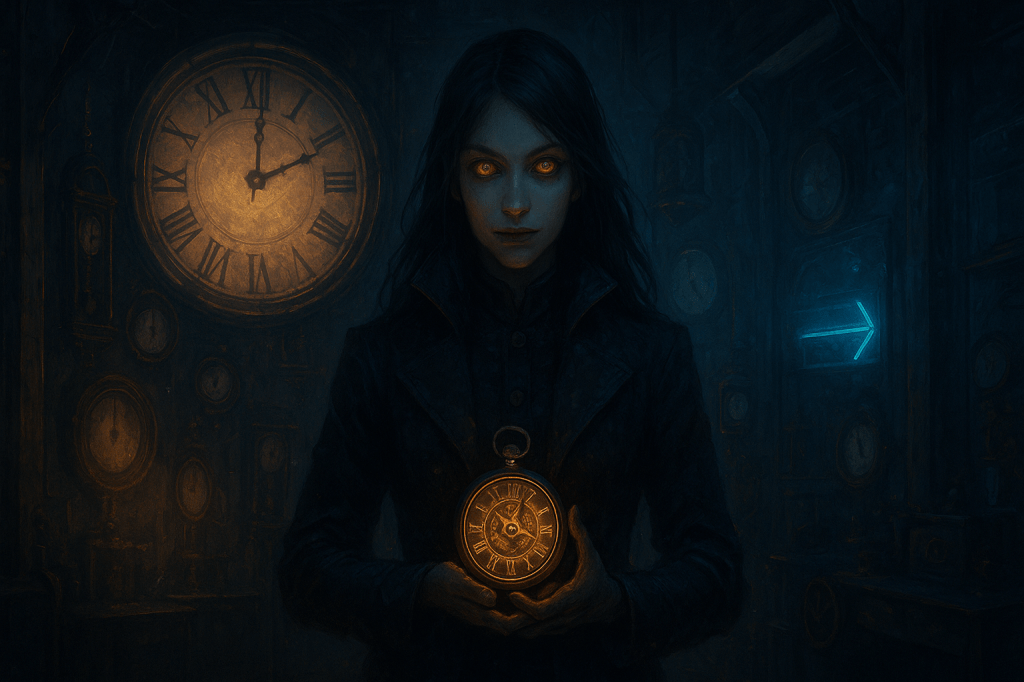
Every wall was hung with clocks.
Some ticked audibly; others breathed in silence.
A few bled light through glass faces; others dripped shadow from cracked gears. The air was a low choir of mechanical voices — each keeping a different rhythm, as if the room contained a thousand alternate presents.
At the centre sat Iria, small, pale, precise — her hands moving over a half-disassembled chronometer that looked more like an insect than a watch. Silver filaments extended from her wrists into the device, pulsing faintly with light. Her eyes — gold-wired augments, old tech from before the ban — registered the slightest fracture in time flow. She was a horologist, one of the few who could still repair the city’s temporal arteries without the blessing of the Meridian Syndicate.
When the door buzzer sounded, every clock in the room hesitated.
A ripple passed through the air, subtle but unmistakable — the sound of chronology holding its breath.
Iria looked up. She wasn’t expecting anyone.
The door opened without her answer.
Three men stepped in, damp from rain, smelling of ozone and arrogance. Their silhouettes were all sharp edges and stolen time.
The leader — tall, mirrored eyes, the kind of grin that never reached the soul — surveyed the room with a sneer. “Neat little museum you got here.”
“I restore,” Iria said softly, setting her tools aside. “Not exhibit.”
He laughed. “Yeah? You fix time, right? Then maybe you can fix your brother’s. He’s run out.”
The words landed like a dropped gear. Iria’s hands didn’t move, but every clock in the workshop skipped a beat — a subtle, collective stutter.
She blinked once, slowly. “Corvin?”
“Wasn’t punctual,” the man said. “Shame. Debt like his doesn’t just vanish. The Meridian says it transfers to kin. You being his only, that means it’s your clock ticking now.”
“I don’t owe your Syndicate anything,” Iria said. Her tone didn’t rise, didn’t shake. “And my brother owed you nothing worth his life.”
“Lady,” the thug said, stepping closer, “in Vorgona, time is life. And your family’s bankrupt.”
He reached for her wrist — the one with the gold filaments. The instant his fingers brushed her skin, a spark of static leapt between them. His hand locked, trembled, then released.
“Careful,” she said. “The clocks bite.”
The men exchanged glances, uncomfortable but still swaggering. The leader nodded toward the door. “We’re done here. She’s got a day to come up with the units, or I start collecting seconds directly.”
They turned to leave.
The latch clicked — a simple, metallic sound — and the door refused to open.
The leader frowned, twisted the handle again. It didn’t move.
Iria didn’t look up. “You shouldn’t have touched me.”
“Open the door,” he growled.
“It’s on a time lock,” she said, almost absently, adjusting the dial on the dismantled chronometer. “Once closed, it obeys only the hour it was set to.”
The second thug slammed his fist against it. Metal didn’t even echo. The sound was swallowed whole, devoured by the air. He spun around. “You bitch—”
“I wouldn’t,” she interrupted, voice still calm, still maddeningly slow. “The workshop is older than Vorgona. Older than the Meridian. It doesn’t like violence.”
The leader took a step forward, towering over her. “You think we’re scared of your toys?”
“No,” she said, standing at last. “I think you should leave. There’s a back door. It will let you out.”
Her eyes glowed faintly — not with light, but with movement, like reflections of unseen clock hands. The leader hesitated, then jerked his chin toward the rear of the workshop.
“Go,” he said to his men. “If she wants to play games, let’s end them.”
They pushed through the curtain at the back, muttering threats.
Iria watched them go, then turned the small brass dial on her workbench a single notch backward.
The workshop exhaled.
Every clock began to tick against itself.
From behind the curtain came a shout.
Then another.
Then silence.
The leader turned. “What did you do?”
Iria regarded him with something that wasn’t quite pity. “You asked for time,” she said. “Now you have it. All of it. Too much of it.”
The man backed toward the rear, confusion edging into fear. He reached for the curtain — and froze.
The air was thicker now, slow as syrup.
Each second stretched into a minute, each breath into a lifetime.
The workshop’s light dimmed, pulsed, dimmed again.
“Try the door,” Iria said quietly. “If you can still find it.”
She returned to her bench, the smallest of her clocks chiming three times — once forward, twice in reverse.
The man turned. The door behind him was gone.
And the workshop’s ticking grew louder.
The Clockwork Trap
The back room of Iria Hale’s workshop was larger than the building that contained it.
The thugs stumbled through the curtain and found themselves in a space that shouldn’t have fit — a labyrinth of hanging pendulums, mirrored corridors, and clock faces embedded into walls that shimmered like mercury. The air shimmered with a faint hum, as if every molecule were vibrating at a different tempo.
One of them — the younger with a violet datajack in his neck — muttered, “What the hell is this place?”
His voice seemed to arrive a second too late.
The leader followed, jaw tight, pistol already drawn. Behind them, the curtain fluttered shut on its own and turned to solid brass.
They were inside the mechanism now.
The nearest pendulum swung lazily through the air. It was massive, its rod a gleaming spine of gears, its weight marked with runes that glowed faintly as it passed. Each swing left a trail of light that lingered a moment too long — as if the pendulum were dragging reality behind it.
“Just find the exit,” the leader growled. “She said there’s a back door.”
They moved deeper. The air grew heavy, viscous. The rhythm of their footsteps no longer matched the sound of them.
One man’s voice echoed before his lips moved. Another’s shadow lagged behind by a step.
Time had come unthreaded.
The youngest of them raised his gun toward a corridor that seemed to fold back into itself. “Something moved,” he said, breath fast.
He fired.
The bullet left the barrel — and stopped.
It hovered nose-first, the air around it trembling like disturbed water. He stared open-mouthed as the smoke from the muzzle rolled backward into the chamber.
Then, the bullet began to reverse, sliding neatly back into the gun. His finger twitched. The world hiccupped. Suddenly he was holding the gun again — unfired — but his hand was bleeding as if it had misfired a hundred times in between.
The leader grabbed him. “Drop it! Drop the—”
The air tore open with the sound of grinding gears.
Mirrors bloomed from the walls, tall and thin, reflecting the men from impossible angles. The second thug — broad, scarred — looked up and saw a dozen versions of himself in the glass.
Each reflection was different.
One with a child’s face.
One grey-haired and shaking.
One decayed, jaw slack and empty-eyed.
They moved independently, out of rhythm with him. He shouted, backing away, but his reflection didn’t — it stepped forward, reached through the mirror, and grabbed him. The glass didn’t break; it rippled. The reflection pulled him inward as though swallowing its own echo.
When it was done, the mirror showed only his older self, smiling faintly, watching the others.
The leader stumbled backward, swearing. The room had no corners anymore. Every direction curved toward the same vanishing point.
He turned — and froze.
The youngest was on the floor, clawing at his skin. His hands had turned skeletal, the flesh melting from them as years devoured him in seconds. Hair bleached, eyes sunk. He screamed once, then was silent, a heap of dry bone and dust.
The leader’s breath came in shallow bursts. He aimed his gun at nothing and shouted into the humming air.
“What do you want from us?”
The clocks answered.
A thousand ticking hearts, each out of sync, merged into a single low, throbbing tone — like the sound of a temple bell struck from within. The floor trembled. The pendulums moved faster, carving trails of light into spirals.
From somewhere unseen, Iria’s voice came — calm, distant, impossibly near.
“You’ve stolen enough hours from others.
Now the hours will take you back.”
He fired blindly at the sound. The bullets left his gun and aged midair, crumbling into rust before they hit the wall.
The hum rose to a scream.
Every clock in the room began to turn backward.
The leader felt his heart seize.
He gasped — and saw his own breath retreat into his lungs. His last shout reversed, words unspoken, eyes unseeing. His body folded inward like a film rewound, bones shrinking, blood cooling, time reclaiming its debt.
When it was done, the room was empty again.
The pendulums slowed. The mirrors stilled. The air settled into quiet, thick with the faint metallic scent of spent chronology.
Iria Hale stepped through the curtain, her presence making the clocks bow their ticking in unison. She surveyed the room — no bodies, only echoes. The dust where one had aged away shimmered faintly, then was drawn into the floor like sand into an hourglass.
She reached for the central pendulum and pressed her hand against its surface. The glow dimmed.
The workshop sighed.
A small clock on her wrist wound itself forward two minutes.
She smiled faintly.
The workshop was fed again.
The Debt Repaid
The rain hadn’t stopped.
It never did in Vorgona — it only changed rhythm, like a dying metronome.
The streets outside Iria Hale’s workshop were silent now, save for the low hum of turbines and the distant mechanical sighs of the city. Three men had entered that building earlier. None had come out. The Syndicate took notice quickly.
Hours later, a car slid up to the curb — black, chrome-lined, the kind that absorbed light instead of reflecting it.
From the back stepped Marek Voss, the Meridian Syndicate’s boss. He wore a coat that shimmered like oil and gloves too clean for the district. His eyes, augmented decades ago, ticked faintly as they adjusted focus — one dialled forward by seconds, the other backward by minutes. He could see time from both ends.
He looked at the door to Iria’s workshop, at the faint shimmer that hung around its frame.
“Open it,” he told his driver.
The driver hesitated, swallowed, then reached for the handle.
The door opened easily. Too easily.
They stepped inside.
The air was dry and cold, heavy with the scent of copper and candle-wax. Every surface gleamed faintly with condensation. The clocks ticked softly, rhythmically, perfectly. Nothing out of place.
Voss’s gaze moved over the walls — the pendulums, the brasswork, the neat rows of devices that seemed more like reliquaries than tools.
“Hale,” he said, his voice low, cultured, heavy with command. “We need to talk.”
Iria was standing behind her bench, polishing the face of a small timepiece with a strip of velvet. Her hands didn’t tremble. Her expression didn’t change when she saw him.
“I was expecting you,” she said.
“I doubt that,” Voss replied, stepping closer. “Three of my men came here. They haven’t returned.”
“Yes,” she said simply. “They arrived on time. That’s more than most.”
He studied her, unreadable. “You understand the seriousness of this.”
“I understand many things, Mr Voss.” She turned the timepiece in her hands, the second hand ticking once, then twice. “Including punctuality.”
He took a slow step forward. “You killed them.”
“No,” she said, looking up. Her eyes caught the lamplight like liquid gold. “They simply ran out of seconds.”
The boss’s jaw tightened. “You think you can play word games with me, clockwitch? I own the minutes of this city. Every second that breathes, I buy and sell.”
Iria tilted her head, smiling faintly. “Then you should have bought a better watch.”
For a moment, silence. Only the sound of a thousand clocks breathing together.
Voss drew a small device from his coat — a temporal stabiliser, humming faintly with blue light. “Do you know what this is?” he asked.
“Of course,” she said. “A crude imitation.”
He raised an eyebrow. “Of what?”
She nodded toward the surrounding room. “Of this.”
He looked around. The walls had subtly changed. The door behind him was gone again, as if it had never existed.
The air pulsed once — low and slow — and all the clocks reset to zero.
He realised then that every second he’d spent inside had already been measured and counted.
Iria set the timepiece down and met his gaze.
“Mr Voss,” she said softly, “you’re late.”
The clocks began to tick — one, then another, then all at once — a deafening symphony of precision and inevitability.
The light in the workshop flared, warped, folded back on itself.
Voss reached for his stabiliser, but it was already rusting in his hand.
He met her eyes, ready to curse her name — then stopped.
The lamplight caught them, and he saw her irises weren’t irises at all but tiny, ticking watch faces, each hand spinning in opposite directions, keeping every possible hour at once.
For a heartbeat he understood — every debt, every second, every death in Vorgona passed through those eyes before it was spent.
The realisation came too late. His stabiliser crumbled to dust, his flesh following, his last breath folding neatly into her silence.
Iria blinked. The little watches reset.
Time went on.
The workshop sighed once, long and tired.
Outside, the rain kept falling, steady now, clean and indifferent.
The neon signs flickered back to life.
The city’s heartbeat resumed.
Inside, Iria adjusted a dial, wound her brother’s old chronometer, and placed it beside her own.
The seconds aligned perfectly, yet Iria’s eyes ticked on.
© B.C. Nolan, 2025. All rights reserved.
 English Voodoo
Leave a comment