
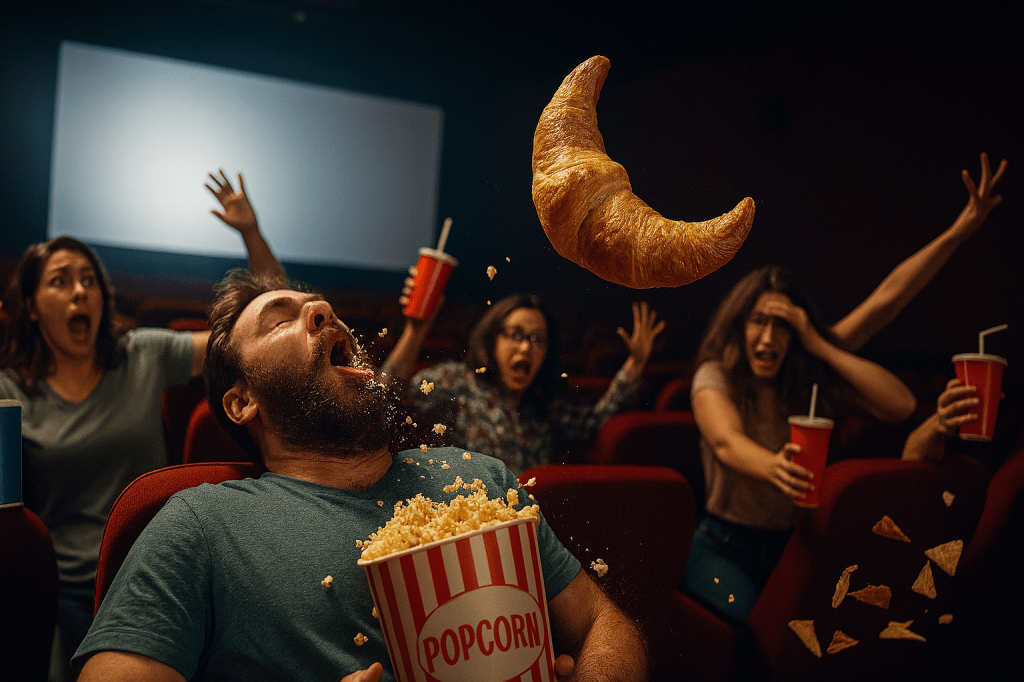
The cinema shuddered as the first croissant leapt from the screen, spinning like a buttery crescent moon. It struck a man in the jaw with a delicate crack, sending him sprawling into a bucket of popcorn. Patrons shrieked, flailing with soda cups and nachos, their arms slicing through the air in a futile mimicry of martial arts. The croissant twirled back to the screen, triumphant, a pirouette of predation.
From the screen, a battalion of baguettes slithered down the aisles, long and rigid. They jabbed, skewered, and prodded with aristocratic precision, indifferent to the surrounding chaos. Each strike was deliberate, rehearsed, a commentary on power: unyielding, sharp, consuming whatever lay beneath. One baguette pinned a man to the seat, slicing his pretzel in two before gliding onward like a lethal conductor.
Sourdoughs rolled in next, heavy and ancient. They barrelled forward, crushing popcorn machines under their weight, groaning with the authority of tradition. Patrons tried to resist, swinging stolen focaccia shards, but the sourdoughs were immovable, a grotesque metaphor for entrenched societal forces. A particularly large loaf squashed a small child’s cotton candy, leaving only threads of pink in its wake.
Focaccia erupted in showers of sharp fragments, ricocheting like deadly confetti. They bounced off walls, ceilings, and the heads of the panicked, striking indiscriminately. Each fragment was a flattened reflection of middle-class panic: scattered, confused, trying to do harm but ultimately powerless against the surrounding forces.
Ciabatta lunged in unpredictable arcs, pliant and treacherous. Patrons leapt or ducked, but each ciabatta found a gap, flipping in midair and slamming into knees and elbows. Its elastic resilience represented opportunists, surviving the chaos and using it to their advantage. One ciabatta bound a group of fleeing patrons together with sticky dough, a subtle nod to social entanglements that trap even the clever.
Then the hot dog roll appeared, grotesquely swollen with ambition. Its pastry mouth opened wide. A man froze, eyes wide, and was swallowed whole. The roll chewed him thoughtfully, its interior a soft, digestive theatre. Silence fell, the audience unsure whether to laugh, scream, or vomit. In this moment, the metaphor was clear: unchecked ambition devours itself and those around it.
And above all, the giant French baguette descended — long, rigid, inevitable. It devoured the hot dog roll, and the man within, in one majestic, grotesque bite. It towered over the cinema like a monolith of predation. Patrons scattered, but crumbs fell from above, a reminder that society always leaves traces of itself behind.
Bagels joined next, rolling in synchronised arcs, forming entrapments that encircled fleeing patrons. Pretzels twisted into knots, colliding with croissants midair, creating a ballet of baked goods that was both absurd and horrifying. Even the humble rolls and buns had movements: leaping, bouncing, twirling, each representing the lower classes caught in the chaos of predatory society.
Breads collided in midair — baguettes stabbing at sourdoughs, croissants ricocheting off ciabattas, focaccia shards showering everyone like lethal confetti. The hot dog roll, now empty of its victim, stared blindly, as if questioning its own existence. The French baguette lumbered away, leaving only the wreckage: sticky velvet seats, shattered popcorn, and an audience in various states of horror and awe.
The marquee flickered: SOCIETY CRUMBLES. The air smelled of yeast, blood, and irony. Patrons slowly realised the absurd truth: in this theatre of bread, they had been complicit, dancing alongside chaos, chewed and reborn in crumbs.
The French baguette emerged from the cinema like a colossus of crust, its rigid length casting long, absurd shadows across the silent streets. Windows trembled. Streetlamps flickered. A stray cat yowled as crumbs cascaded from its cracked surface, tumbling in slow-motion arcs onto the pavement below. Each fragment landed like tiny monuments to consumption.
The city itself seemed to recoil, buildings leaning slightly as if bowing to the absurd tyrant of dough. Cars screeched to a halt as pedestrians froze mid-step, eyes wide, jaws slack, caught in the hypnotic gravity of baked authority. The baguette’s every stride, the baguette left a trail of crumbs — half bread, half metaphor — a breadcrumb map of society’s appetite for itself.
From alleys and corners, other breads began to stir. Croissants pirouetted across rooftops, rye loaves barrelled down streets, and focaccia fragments rained from balconies. The dance had left the cinema, the grotesque ballet of predation now a citywide performance.
Above, the neon sign of the cinema flickered one last time: SOCIETY CRUMBLES. Somewhere, muffled laughter and distant screams mixed into a single, absurd symphony.
The French baguette paused in the middle of the boulevard. Its rigid shadow stretched across the city like a verdict. A hot dog roll, carrying a trembling human still inside, tried to flee. The baguette extended, swallowing it in one smooth, inevitable motion. Silence fell.
And the city exhaled. The streets were covered in crumbs. The smell of yeast hung in the air — intoxicating, oppressive, ironic. Somewhere, a voice muttered — maybe from the baguette, maybe from the wind — we all devour each other, slice by slice.
Then the baguette continued its march, unstoppable, a grotesque allegory walking the streets, leaving a trail of societal carnage in its absurdly perfect wake.
© B. C. Nolan, 2025. All rights reserved.

 English Voodoo
Leave a comment