
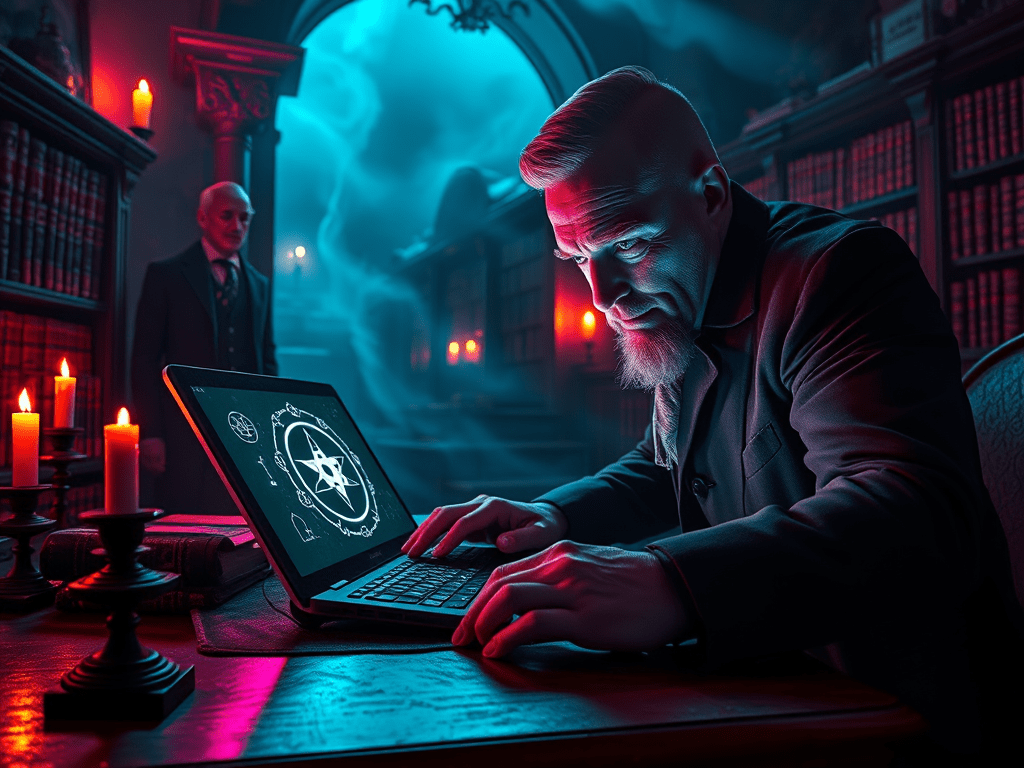
A storm clawed at the windows of Boleskine House like something ancient trying to return. Inside the library, candlelight guttered in slow rhythm, throwing dancing shadows against walls lined with tomes bound in serpent skin and inked in languages that no longer had speakers—only echoes. The air smelled of dust, wax, and something older than either: knowledge that was never meant to be known.
Aleister Crowley sat alone at a heavy oak desk, hunched over Liber 0. The Book of Change pulsed beneath his fingertips, not metaphorically, but with literal motion—its glyphs undulated and rearranged themselves as if the book were dreaming, or perhaps dreaming him. He watched the ink on the page bleed in reverse, then settle into an arrangement he hadn’t seen before.
He smirked. “So, it’s already begun.”
The candle beside him flared, dipped low, then steadied with unnatural precision. Outside, the wind shifted direction as though taking new orders. Somewhere deep in the house, doors unlocked themselves with the calm precision of a ritual just reaching its cue.
From the far side of the library, between two tall shelves stacked with esoteric horrors, a voice emerged—measured, urbane, and unplaceably ageless.
“Indeed, it has, Mr Crowley.”
Crowley didn’t startle. He merely tilted his head, eyes sharp as polished obsidian. From the shadows stepped a tall man in a deep burgundy tailcoat. His presence was eerie, not for its grotesqueness, but for its precision—like a painting so perfect it becomes uncanny. His skin was smooth, almost glazed, and his smile was carved with the deliberateness of architecture. He moved like a memory of etiquette.
“The house speaks now?” Crowley asked, amused.
“Not the house,” the figure said. “I am the innkeeper of its intention. Think of me as the hotel’s butler. I tend to its rooms—and its revelations.”
Crowley leaned back, crossing one leg over the other. “And what service do you offer tonight?”
The butler’s smile didn’t change, though it seemed to darken somehow.
“To welcome you. And to inform you that what you are reading is not a book, but an occurrence. Liber 0 is not written, Mr Crowley. It is writing itself into you.”
Crowley tapped a fingernail against the page, which responded by exhaling a new line of text—this time in a tongue he only remembered from dreams he’d had while momentarily dead.
“A recursive prophecy,” he mused, “how fashionable.”
“Not prophecy,” the butler corrected. “Programming.”
“It’s what’s known as a computer. Or, to be more precise, a laptop, but often referred to a book of some kind.”
For a moment, only the sound of the candle flame could be heard, its little sputtering heartbeat blue at the edges. Then the figure stepped backward, not turning, simply retreating—until he dissolved into the shadows between the bookshelves with the ease of a thought forgotten.
Crowley stared down at the futuristic book. Its screen rippled like a surface being watched by something underneath.
“Well then,” he whispered to the flame, “It seems I have a lot of catching up to do.”
*
Boleskine Hotel stood beyond time, an island within the currents of fate. To the untrained eye, it was an old manor nestled against the black waters of Loch Ness, but those who entered knew better. The air shimmered with something unseen, as if reality itself wavered at the threshold. Those who found their way here had not truly arrived of their own will.
The guests drifted in like whispers carried by the wind. A painter and her psychologist husband, whose essays echoed his wife’s work with forays into the afterlife. Both descendants of the Windrush generation. A Restaurateur, and his wife, a paediatrician devout in faith yet unknowingly guided by something beyond it. Two travellers of the world, one from the Orient the other from the West, who had stumbled upon Boleskine as if by accident, yet knew they were precisely where they needed to be.
*
Inside, the rooms breathed. They were not merely adorned but sculpted by unseen forces. Each chamber became a microcosm, a celestial map woven into incense, colour, and ancient sigils. Here, conception was not random; it was ritual, dictated by cosmic alignments and guided by the hands of a knowing host.
Aleister Crowley stood before the great astrological wheel, its spokes glimmering with planetary movements only he could decipher. He turned it slowly, his fingers brushing against constellations like the strings of an instrument. The moment had to be exact. The heavens, the earth, the very fabric of the unseen, had to be in alignment. Tonight, the future would be forged in flesh and spirit.
*
The air was thick with opium and poppy smoke, curling through the dim candlelight. The walls bore the deep hues of indigo and black, marked with the sigils of Saturn. Pearls lay scattered in bowls of water, reflecting the flickering flames. Cypress branches lined the edges of the room, their scent mingling with myrrh and something older, something ancient.
Samuel Day’s parents lay entwined in the sacred act, their breath mingling with the incantations woven into the very fabric of the space. The psychologist, trained in the mind’s workings, found himself slipping beyond reason, guided by forces beyond cognition. The painter traced unseen patterns in the air, fingers dipped in star sapphire dust. Their union was not just physical; it was alchemical. A summoning. A creation. Outside, the walls of the hotel stretched. Something stirred in the void.
*
Fiery Opals adorned the chamber, etched with sigils half-buried beneath layers of mirrored light. The scent of storax and mastic curled through the air like a question never fully answered. Orange and gold danced across the walls, refracted into shifting geometries by the flickering of the candlelight—patterns within patterns. Hassan’s parents moved together, not as lovers, but as glyphs in motion, fulfilling a sequence older than memory. Every step, every breath was a syntax—an offering to a language that spoke them into being. He used to say feeding a table was like summoning a god. Now he knew it was literal.
The restaurateur, who had spent his life mastering the alchemy of appetite, now fed an unseen order, a ritual too vast to name. The paediatrician, guardian of delicate futures, found herself inhabited by a brilliance not her own—becoming the vessel of a coded will inscribed deep within the splendour of illusion. She delivered infants by touch and intuition—now she was delivering something older, something recursive.
Mercury watched.
The amber lattice of Hod pulsed—data, symbol, spell—rippling through the astral syntax as Hassan’s spirit began to take shape, not in flesh, but in form. Ideas gave birth to essence. The air shimmered like a veil of stained glass, thin with meaning. Somewhere beyond, in the hollows of the Highlands, something paused mid-step. It had recognised the pattern.
*
Lightning flashed through the red-stained glass, illuminating the room for a fraction of a second before plunging it back into the glow of flickering candlelight. The walls pulsed, alive with the force of raw power. Oak branches twisted upward, forming shapes that seemed almost deliberate, as if the wood itself knew the names of forgotten gods.
Rosie’s parents moved together beneath the sigil of Mars. Ruby shards caught the dim light, their crimson glow mirrored in the woman’s half-lidded eyes. Her husband’s breath was fire against her skin, their union an act of will made manifest. In this moment, there was no past or future—only the raw, electric force of creation.
Neptune roared in the silence. Outside the hotel, the stars trembled on the surface of the loch.
As the rituals reached their crescendo, the wheel turned. Crowley watched, eyes gleaming with the satisfaction of a man who had long since given up on the illusion of coincidence. The hotel shifted, expanding outward into something older, something vast. The doors that had been closed for centuries creaked open ever so slightly. Something had changed. Something had been born.
Far beyond the veil, unseen figures stirred. The Kabal, already searching, felt the ripple before they could explain it. But they were not alone. For the first time in centuries, something else was watching.
*
It began not with a trumpet, but with a silence that reached backwards. Old codes trembled. Forgotten sigils flared into relevance. In the data fields and ley lines, ghosts of the unborn whispered in machine tongues. Those attuned to the deeper frequencies reported dreams of inverted suns and bleeding clocks. Across every domain—magical, digital, psychic—the same message: the lock had turned.
The world outside tightens, its grip turning to steel. The sky above the cities glows with artificial halos, the streets policed by drones that do not blink. The Consensus Mechanism spreads like a shadow over waking minds, rewriting perception, memory, truth itself.
But Boleskine House remains a sanctuary—an anomaly untouched by the great rewriting. Within its impossible halls, three children grow under the tutelage of a man who should not exist, in a house that defies the rules of time.
*
Hassan, the Strategist. He learns the language of deception, the art of the unsaid. Crowley teaches him to speak in riddles, to layer truth within lies so deeply that even he begins to question which is which. He studies forgotten texts, letters written in the margins of reality, and soon, he knows how to slip between the cracks. But deception breeds doubt. How much of himself is real? If he rewrites a memory enough times, does it cease to be his own?
And yet, his knowledge of illusion makes him the one who sees through the veil of the world most clearly.
Samedi, the Resurrectionist. He touches the boundary between life and death and finds it thin. His mother, a painter, gave him eyes for colour; his father, a psychologist, a mind attuned to the depths of the soul. Under Crowley’s guidance, he moves beyond both. He dissects the dead with the precision of a surgeon, but his scalpel is code, his stitches digital. He learns necromancy in a world where bodies can be remade from data, where consciousness lingers in the circuits of forgotten machines.
But the past haunts him, whispers in every fragment of lost souls he revives. He cannot let go. If the past can always be retrieved, why accept death at all?
Rosie, the Chaotic Flame. Where the others work with knowledge, Rosie is power. Chaos bends around her, spirals in strange loops when she walks. She does not read books; she sets them alight and speaks their secrets aloud in tongues unknown. She does not learn spells; she wills them into being through sheer presence. She is wild, electric, untethered.
The others think she is lucky—Crowley knows better. She is ruled by fate as much as she resists it, her hands on the strings that pull her but unable to cut them. Choice is a trickster’s game, and she is the trickster’s favoured child. The three of them move through the cracks of reality, becoming stories, urban myths. People see glimpses of them in reflections, hear their voices in dead channels, feel their presence in places they were never meant to be.
English Voodoo—they are spoken of in hushed tones, a glitch in the world, a contradiction to the Consensus Mechanism itself. And the Consensus hates contradiction.
The Kabal tightens its grip. It feels the shifting of the script, the stray marks on its sacred ledger. The children are moving too soon, becoming too known. They begin to draw attention, and attention is dangerous. The machine can tolerate anomalies only so long before it erases them.
And so Crowley gathers them by the fire, the flames casting shadows that do not belong to them. He laughs, but his eyes are hard, knowing.
“Not yet.”
His voice is a warning, but it is also a prophecy. The world is not ripe for change. Not yet.
The children are restless. They do not understand the weight of the waiting. But they will.
*
The world outside my wallss is teetering on the edge—corporations have merged with governments, digital surveillance has erased privacy, and human freedom has become a rarity. Resistance is no longer an abstract idea. It is the only path forward, or the world will collapse under its own weight.
Boleskine has grown, not just in size but in purpose. It has become more than a sanctuary; it is a fortress, its walls fortified with wards and ancient protections, a place where time and space bend, a haven against the digital night that seeks to swallow the world. Each of its rooms now pulses with an energy greater than anything anyone could have predicted. The hotel itself has become a living, breathing entity, intertwined with the fate of those within it.
On the night of the full moon, the ritual hall is bathed in firelight. Shadows twist and flicker on the walls, their movements not of their own accord. The air is thick with incense and the crackling of unseen forces, every inch of the room vibrating with raw potential. The three children—Hassan, Samedi, and Rosie—stand before Crowley, who gazes at them with a knowing smile.
“I called you here for a reason,” Crowley begins, his voice calm but carrying the weight of inevitability. “You weren’t born here by chance. You were summoned.”
The words hang in the air, heavy and charged, like the calm before a storm. Hassan’s brow furrows, the flickering firelight casting sharp shadows on his face. Samedi’s hands twitch, his fingers tracing patterns in the air, while Rosie remains still, her gaze fixed on Crowley. Each of them feels it—the surge of destiny, pulling them closer to something larger than themselves.
“This isn’t a war in the way you think,” Crowley continues, stepping forward. “It’s a ritual, and you are the ones who must perform it.”
The room grows colder, and for a moment, they are no longer in the hall of Boleskine. The walls melt away, replaced by the vastness of space, the stars swirling like ink in an endless void. Hassan’s heart races. Samedi’s pulse quickens. Rosie’s breath catches in her throat. Before them stands a doorway, an archway that opens not into the hotel, but into the heart of the conflict itself.
“Reality is a contract,” Crowley’s voice echoes, reverberating in the infinite expanse, “and the Kabal has been writing it for too long.”
He gestures toward the open portal. The three of them look into the future—a vision of what is to come. They see the war unfolding, battles fought on fields that aren’t just of land, but of the mind, the soul, and the very fabric of existence. A war not fought with weapons, but with words, with will, with power.
For a brief moment, they glimpse the scale of the conflict, the lives lost, the battles they must face. The vision flickers—a glimpse of themselves, standing in the fray. They see the faces of the fallen, the unspeakable horrors, and something more—something that echoes within them.
The realisation hits them all at once: they are not just watching the war. They are part of it. They are already inside the story, playing a role in a tale that is still being written. The threads of fate have already begun to twist around them, and there is no escaping the path they must walk.
Crowley steps closer, his eyes locking with each of theirs. “You are the agents of change. You will rewrite this reality. Your names are already etched in the next Book of the Law—but this time, it’s still being written. Every act of defiance, every challenge to the Consensus Mechanism, it all feeds the page. The book will change as you change the world.”
Hassan feels the weight of the words, the impossible nature of what lies ahead. He has been trained in deception and strategy, but the game has grown more complex, more dangerous.
Samedi, with his understanding of life and death, feels the pull of the necromantic powers at his disposal, but even they feel inadequate in the face of what is coming.
Rosie, her chaotic energy swirling within her, knows that she is the wildcard, the one who can tip the balance, but she can’t shake the feeling that she may not control what she unleashes.
For a moment, there is silence. The air is thick with the magnitude of what they must do. And then Crowley speaks again, his voice steady and sure: “And now, the war begins.”
As the words leave his lips, the ground beneath their feet trembles. The stars flicker in the sky. And far off, in the depths of the universe, the first of many battles takes form. The call to arms has been made. The world, and the very fabric of reality itself, will never be the same again.
And thus, I—the Hotel, the Innkeeper of its Intention—continue to observe. I shelter the guests. I guard those born within my walls.
But beyond these blood-soaked bricks, the world gnaws at itself.
I am helpless to stop it.
Helpless… but not blind.
When the Conception Ritual was performed, it rang like a bell through the ley—a sound the Kabal could not ignore. Their response was swift. But not reactionary. It felt… prepared.
As if they had expected it.
As if they had allowed it.
What followed was not a retaliation.
It was a ritual of their own.
And whatever was conceived that night, beneath Salisbury Planes, it rewrote the rules.
© Aiwaz, 2025. All rights reserved.
 English Voodoo
Leave a comment