
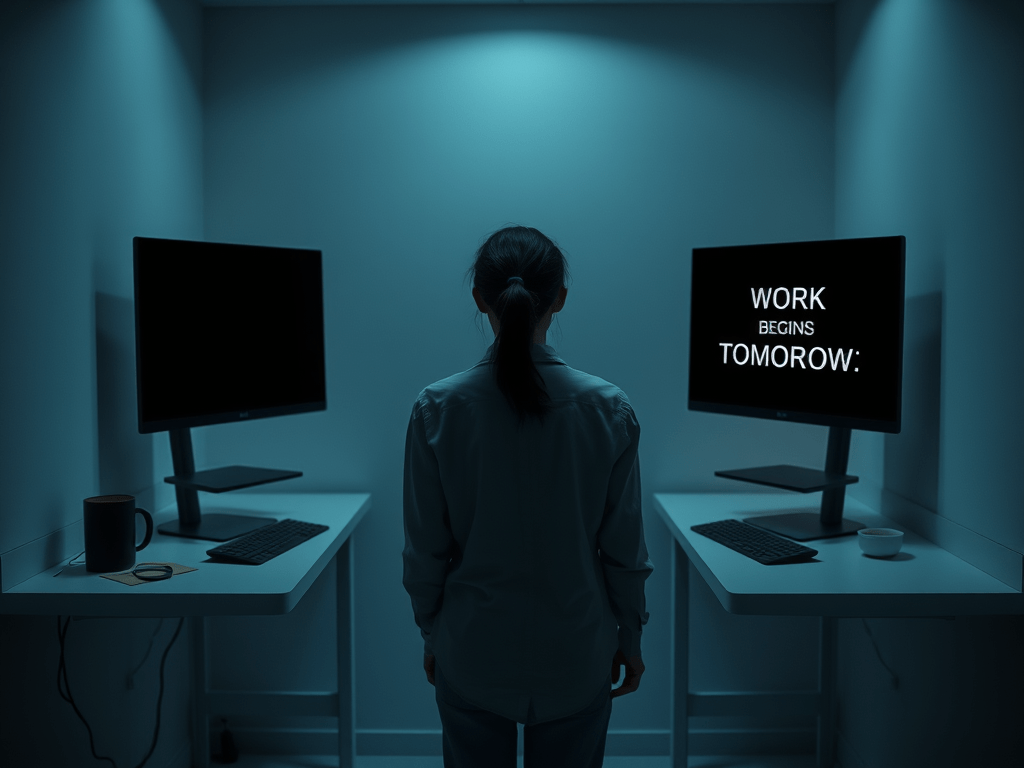
The first thing he noticed was the silence.
Not just quiet—true silence. No distant traffic, no humming of electricity, not even the soft murmur of his own breath. It was the kind of silence that made his heartbeat feel intrusive.
He didn’t remember stepping into this room. Couldn’t recall a flight, a car ride, or even walking through a door. Just that he had taken the job. High pay. Minimal details. A contract signed in a room he couldn’t quite picture.
The air smelled…clean. Not fresh, not stale. Just clean.
A woman stood across from him, blinking in the dim light. She had dark hair pulled into a tight ponytail, a sharp, analytical gaze scanning the room the way a cat sizes up a new space.
“Do you remember getting here?” she asked.
He swallowed. His throat felt dry. “No.”
The room was small. Two desks, each with a chair and a sleek, black screen. A dumbwaiter built into the wall. Two doors—one behind each desk. Probably leading to individual sleeping quarters.
A sound echoed through the space.
A loud bang.
Like a steel door slamming shut, somewhere far away.
The woman tensed, tilting her head slightly, as if straining to hear more. But the silence returned just as fast as it had been broken.
He cleared his throat. “Maybe someone else just arrived.”
She didn’t look convinced.
A flicker of movement in the corner of his eye—the screen on his desk powered on. Just a single line of text, crisp against the void-black background:
WORK BEGINS TOMORROW.
The routine settled in quickly.
Each morning, the screens flickered to life with a single command:
BEGIN EVALUATION.
The database was vast. An endless list of names, faces, and statistics. Each file contained a person—age, occupation, medical history, criminal record, genetic markers. A number at the bottom. Their “score.”
They were given no instructions. No overseer to explain the rules. Just an interface. Two buttons. A choice.
One button was green. One was red.
The first time he hovered over the red button, his stomach turned. It was just a number. A name. But somewhere out there, a real person existed behind that data.
Or did they?
The first few days, they spoke little. A few awkward exchanges over meals, small talk that never felt quite right. Like they were both avoiding something.
The dumbwaiter delivered food three times a day—nutrient-packed, tasteless squares of protein. No labels. No packaging. No sign that anyone had made it.
Sleep came easily, but waking up was jarring. The silence. The absence of dreams. The feeling of being reset.
One evening, over their bland meal, she finally broke the spell.
“We don’t know where this place is,” she said, voice low. “We don’t know how we got here. We don’t even know who we work for.”
He swallowed his bite, suddenly aware of the weight in his gut. “It’s a job. We applied. We took it.”
“Did we?” she asked, eyes locking onto his. “Are those real people we’re evaluating? Are we kil?..”
Another bang.
Louder this time.
Like a door slamming shut just down the hall.
They both turned their heads toward the sound. Stared at the row of identical doors lining the warehouse-sized space outside their office.
“Maybe someone else just arrived,” he said again, but this time, it sounded hollow.
She didn’t respond.
Instead, she reached under her desk, running her fingers along the underside. When she pulled her hand back, there was scratched into her skin. Tiny flakes of paint and splinters.
A message, carved deep into the wood.
IT’S RIGGED.
Their screens flickered. A new name appeared. The choice awaited.
Neither of them moved.
It started with something small. So small he almost dismissed it.
She was staring at him. Not in the usual way—when they talked, when they hesitated over the buttons, when they ate in silence. No, this was different. She was studying him.
“What?” he asked, trying to focus on the file in front of him.
She didn’t answer right away. Just kept looking, as if turning a puzzle piece over in her mind.
“You seem… familiar.”
His fingers paused over the keyboard. “Familiar how?”
“I don’t know. Like I’ve met you before.”
A joke sat at the tip of his tongue—‘Maybe we worked together before this.’ But it felt wrong. Forced. Because now that she’d said it… he felt it, too.
He glanced at her screen. The dull glow reflected off her face, casting shadows under her eyes. But the name listed wasn’t his. Some stranger. Just data.
And yet…
A shiver ran down his spine. He turned back to his own screen.
A new profile had loaded. Another name, another number. But as he read the text, his vision blurred. His pulse quickened.
He saw his own face on the screen for a fraction of a second, a moment long enough to question reality.
Distorted. Wrong. Like an old photograph stretched in the wrong direction. A flicker of static, then—gone. Just another random name.
He blinked hard. Forced a breath. Did she notice?
She was still watching him.
Neither of them pressed a button.
Neither of them said anything.
And then—
BANG.
This time, the sound was closer.
This time, the walls seemed to vibrate.
This time, he felt something new.
A memory trying to surface.
They stopped pressing buttons for a while.
Maybe the machine noticed, maybe it didn’t. Their screens continued to cycle through names, faces, numbers. Waiting. Expectant. The silence between them thickened.
She was the one who broke it.
“We need to check the doors.”
The ones in their sleeping quarters locked automatically when they went to bed. But outside, in the warehouse-sized office space? There were dozens. Rows upon rows of identical metal doors lining the walls, like some abandoned government archive.
They had never tried to open them.
BANG.
They flinched. That same distant slamming sound. But this time, it wasn’t distant.
It came from one of the doors.
They exchanged a look. Then, without a word, they moved.
The first handle didn’t budge. Locked. The second—same. The third, fourth, fifth—all the same.
Then one of them turned.
The door creaked open, revealing an office exactly like theirs. Identical. Two desks. Two screens. Two chairs. Two doors leading to bedrooms. A dumbwaiter.
But it wasn’t empty.
The first thing they noticed was the smell—something metallic, like rust and sweat. The second was the dust. A thin layer covered everything, except for the chair that had been knocked onto its side.
And then there was the message.
Carved into the desk, deep and jagged, as if someone had done it in a hurry:
IT’S RIGGED.
The woman ran a trembling hand over the engraving. Her breath was shallow.
He crouched down, looking under the desk. Something caught his eye. A tiny, dark stain in the dust. Dried. Old.
Blood.
“Someone else was here,” she whispered.
Another pair. Another cycle.
BANG.
Louder this time. Closer.
Their screens flickered behind them, like a breath in the dark. A new name appeared.
Neither of them turned to look.
They went back to their office, but something had changed.
Everything felt smaller. The walls pressed in, the glow of the screens too harsh, the silence too heavy. The air itself seemed thicker, as if time had folded in on itself.
The doors. The dust. The blood.
The message carved into the desk.
Neither of them spoke about it. What was there to say? It was proof—undeniable, visceral proof—that they weren’t the first. That this had happened before. That it would happen again.
And still, the screens flickered.
BEGIN EVALUATION.
She sat, staring at her monitor. He did the same. The names kept coming. The choices remained the same.
Green or red. Live or die.
He could feel her watching him, just as he was watching her. Every move they made, every breath they took, now measured and dissected. Had she always exhaled that sharply? Had he always swallowed that loudly?
The paranoia grew like a slow-moving cancer, spreading through the empty space between them.
He started testing things. Small things.
He left his chair an inch out of place. The next morning, it was perfectly aligned again.
She deliberately left her plate in the dumbwaiter instead of sending it back. The next time she checked, it was gone—but there was no sound, no movement. Just… gone.
And then the loudest bang yet.
The walls shook. The lights flickered.
He grabbed the edge of his desk, heart hammering, and turned to her.
She was already looking at him.
“We’re being watched,” she whispered.
His blood turned to ice.
Somewhere behind the walls, beyond the screens, someone—something—was watching.
And they were waiting for them to break.
They weren’t sleeping anymore.
The walls groaned in the night. The doors whispered. The screens never turned off.
Something was closing in.
It started subtly. A flicker in the corner of his eye, like the room was stretching when he wasn’t looking. The air buzzing with something just beneath the threshold of hearing.
Then the glitch.
He had been staring at the screen for too long; the words blurring into unreadable symbols. Just another name. Another number. He reached for the button—
Then his own face stared back at him.
Not a reflection. Not a camera feed.
His face. Stretched, distorted, wrong. Flickering in and out, like an old VHS tape skipping frames.
The name wasn’t his. But the eyes were. The same tired lines, the same unease.
He sucked in a sharp breath—too loud.
She turned. And then she saw it too.
Her screen—her own face staring back.
Not as she was. As she had been.
Hair slightly different. Eyes heavier. Like a version of herself from a loop she couldn’t remember.
A thick, guttural static filled the room. The screens flashed violently, pages of corrupted data scrolling faster than they could process.
Then—
DO YOU UNDERSTAND NOW?
The words slammed onto their screens in stark white letters.
The dumbwaiter slammed open.
A single drawer in the desk snapped open.
Inside:
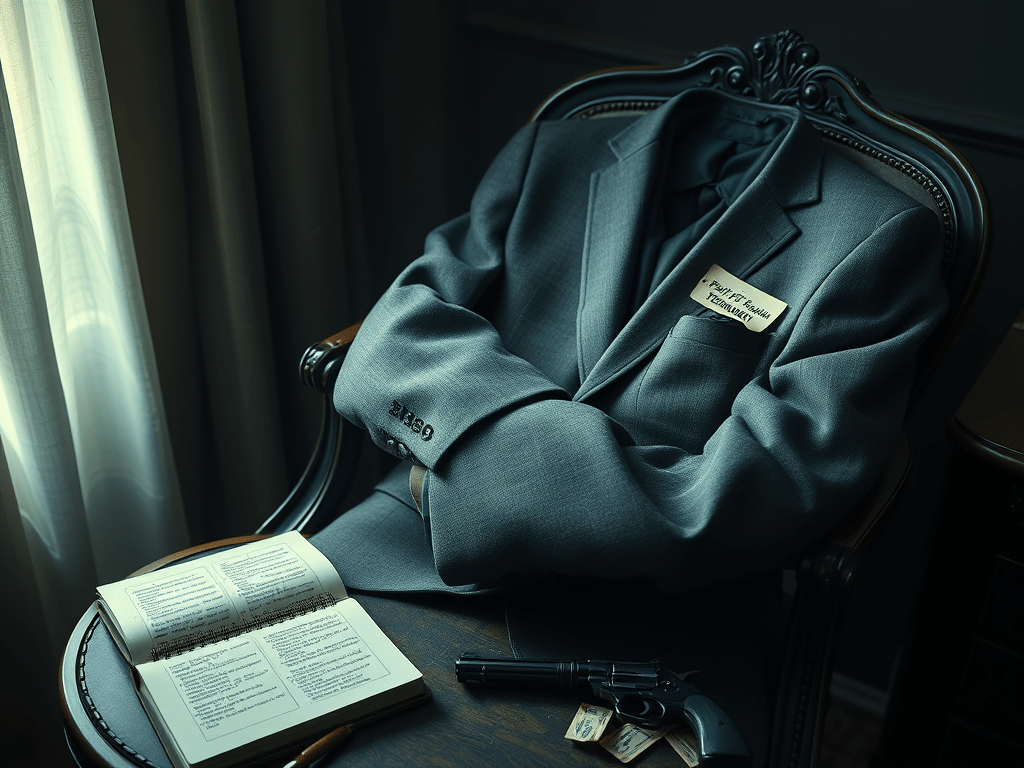
A gun.
They both froze.
The screens flickered again.
A new name had loaded.
Two, this time.
Theirs.
And somewhere in the distance, beyond the walls—
BANG.
The gun sat in the drawer, waiting.
Their names sat on the screen, waiting.
The system had brought them here, through the long corridors of silence, through the quiet, mechanical labour of choosing who lived and who died. And now—now it was their turn.
Neither of them moved.
The dumbwaiter hummed shut with a soft, metallic click.
His fingers curled against the edge of the desk. The air was thick, suffocating. He could hear her breathing—shallow, controlled, but unravelling at the edges.
She was the first to speak.
“How many times do you think we’ve done this?”
A lump formed in his throat. “I don’t know.”
But the answer was there, in the dust, in the message carved into the desk, in the flickering remnants of their own faces on the screens.
This wasn’t the first cycle.
It wouldn’t be the last.
She reached into the drawer. The gun felt heavier than it should. As if it carried the weight of every decision made before this one.
“Maybe if we don’t…” she trailed off, staring at the cold metal.
He swallowed hard. “Maybe the system will decide for us.”
Neither of them had to say what that meant.
They sat there for what felt like an eternity. Two condemned ghosts in an office outside of time.
Then—
BANG.
Fade to black.
A slow pullback.
You find yourself in a long, empty hallway. Dozens—hundreds—of identical doors stretching into the dark. Following a faceless man dressed in a plain black suit.
BANG.
One door goes silent.
Then, the sound of hinges creaking. Another door swings open.
Inside: two desks. Two screens. Two chairs.
A dumbwaiter hums softly, delivering fresh meals.
The drawer slides shut.
The faceless man escorts you in with your new colleague.
The door closes behind him, and the cycle continues.
© Aiwaz, 2025. All rights reserved.
 English Voodoo
Leave a comment