
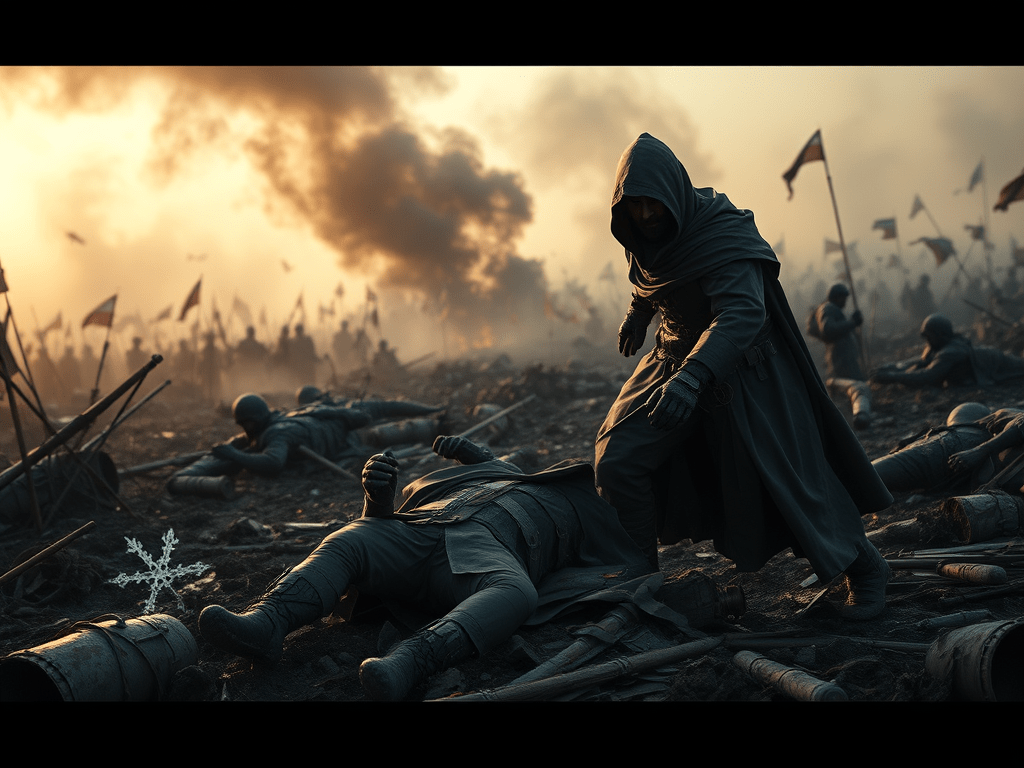
Hassan-i-Sabbah awoke in motion.
A shudder of cold air sliced through his robes, his body snapping into the moment like a blade unsheathed. Beneath him, the ground trembled with distant cannon fire, the stench of sulfur and blood thick in the fog-choked dawn. He did not remember arriving. One moment, he was elsewhere—an eternity of silence—and now he stood amidst the dying embers of an empire’s ultimate gamble.
The Battle of Waterloo.
A field of corpses stretched across the muddy terrain, the clash of steel and the crack of musket fire echoing like the dirge of a dying world. Smoke coiled in the sky, black as prophecy. He had been here before—not in body, but in the whispers of history, the annals of power and deception.
And he knew why he was here.
Nathan Rothschild’s messenger. A single rider, bound for London, carrying the fate of empires in his saddlebag. If Hassan stopped him, if the message never reached its destination, perhaps the world would be spared the stranglehold of war-driven capital. Perhaps.
His gaze cut through the battlefield, seeking movement beyond the slaughter. Then, in the chaos, he saw it—a lone rider cutting through the wreckage, galloping hard toward the horizon.
There. The courier.
Hassan moved with purpose, each step a calculation. He was an Old World assassin in the heart of a New World war. The weapons had changed, but death remained the same.
He descended into the wreckage, unseen among the fallen, his robes blending into the blood-stained mud. With the fluid grace of a shadow, he moved through the dying and the dead until he was close enough to act.
A flick of the wrist. The whisper of steel.
The throwing dagger met flesh.
The rider let out a strangled cry, his body jerking violently before toppling from the horse. Hassan was already moving, reaching the fallen man before the life had fled from his eyes. He wrenched the satchel from the dying courier’s grasp, his breath steady, victorious.
He unfastened the flap, expecting to see the coded message—the key to breaking the cycle. Instead, he found… nothing.
Empty.
A shadow passed over him.
From the crest of the battlefield, another rider emerged.
Hassan’s blood turned to ice. The real courier was still on his way.
He had made a mistake.
The Hand That Wields the Knife
Hassan’s breath curled in the cold air, his fingers tightening around the empty satchel as realization dawned.
He had failed.
For the first time in a lifetime of calculated strikes, he had missed the mark—not with his blade, but with his understanding. The real courier still rode, unburdened, unstoppable.
A sound, like the folding of reality, split the air behind him. A presence slithered into existence—not with footsteps, not with weight, but like a thought given form.
Aiwaz.
Suspended in the shifting, prismatic air of broken causality, the entity regarded Hassan with the detached amusement of a scholar observing a pupil’s first mistake. Its form was fluid, shimmering at the edges, half-seen and half-imagined.
A faint chuckle rippled through the ether.
Aiwaz: “Did you really think it would be that simple? That a single blade in a single moment could carve away the shape of history?”
Hassan rose to his feet, turning slowly. His instincts screamed at him—strike, resist, escape—but against what? Aiwaz did not stand, did not move in the ways men moved. It simply was bending space around it, an observer outside of time.
The assassin remained silent. He had no words yet, only thoughts spiraling outward, unraveling his understanding of cause and effect.
Aiwaz gestured lazily toward the battlefield’s horizon.
Aiwaz: “The other courier still rides. Will you kill him too?”
Hassan’s eyes flickered to the distant silhouette—a dark figure on horseback, vanishing into the smog of war. He knew what had to be done.
And yet, his feet did not move.
A pause. A hesitation. Something gnawed at him, a feeling buried beneath instinct. If he had truly changed history, Aiwaz would not be here.
His grip tightened around the hilt of his dagger. A test.
Hassan: “What game is this?”
Aiwaz’s smirk sharpened.
Aiwaz: “Game? No, no, my friend. You are simply beginning to grasp the nature of the board.”
The air rippled around them, folding like an unseen hand had turned the page of a book. In that instant, Hassan felt it—a weight pressing down, something vast, something watching.
He was no longer a man standing on a battlefield. He was a fragment in a much larger equation.
And Aiwaz, as always, was merely the one holding up the mirror.
The Knife That Cuts Nothing
The battlefield blurred at the edges, war dissolving into something weightless and distant. Hassan felt the ground beneath him, but it no longer felt real. The cries of dying men, the thunder of artillery—all of it faded into a soft, droning hum, like an echo of a world already past.
Aiwaz remained before him, lounging in the space between reality and thought, watching with the patience of an immortal tutor.
Aiwaz: “Ah, you hesitate. Fascinating. You know what must be done, and yet—something stays your hand. A rare thing for one such as you.”
Hassan’s eyes flicked toward the horizon, where the real courier rode onward, untouched, carrying the fate of nations. His jaw tightened.
Hassan: “If I stop him, Rothschild’s empire falls. The wars stop. The world—”
Aiwaz laughed. Not cruelly, but as if he had heard this story before, as if the punchline had been delivered a thousand times.
Aiwaz: “You think time is a blade, that you can cut a single thread and unravel the tapestry? No, Hassan. That is not how causality works.”
The entity drifted forward, hands outstretched as the battlefield froze around them. The world turned monochrome, and in its place, golden lines spread outward, connecting people, actions, and consequences—an endless web of interwoven fates.
Aiwaz plucked a single thread from the air. It shimmered, pulsed, connecting Hassan to the courier, to Rothschild, to men he had never met—kings, thieves, prophets.
Aiwaz: “Kill one man, and another takes his place. Kill ten, and history corrects itself. Kill a thousand, and the architects of fate merely adjust the weight of the scales. The game continues, because the game was never built on a single piece.”
Aiwaz let go of the thread. It snapped back into place, untouched, unbroken.
Aiwaz: “If you had succeeded, you would not be here. I would not be here. This—” he gestured to everything “—would already be different. Do you see now? You cannot change the world by cutting off the head of the beast. You must burn the roots. “
Hassan’s breath was steady, but his mind was a storm.
Hassan: “Then why bring me here? Why tell me this?”
Aiwaz grinned, stepping closer.
Aiwaz: “Because I am giving you something greater than a blade. Something you already possess but refuse to wield.”
The world shifted again; the battlefield replaced by mirrors—thousands of them, stretching into infinity.
In them, Hassan saw himself. But not just one version.
One mirror showed him as a nobleman, his face pale, his attire pristine. Another showed him as a beggar, shrouded in rags, unnoticed. In another, he was a Kabalist, wrapped in the silks of their order, standing beside Newton himself.
He turned sharply. Illusions? A trick?
Aiwaz tilted his head.
Aiwaz: “You believe yourself to be merely an assassin, a killer of men. But I ask you—what is the greatest weapon? A sword? A hidden blade?”
The mirrors rippled, his reflections shifting, reshaping—becoming.
Aiwaz: “No. It is the unseen. The man who walks among his enemies, unnoticed. The hand that moves the pieces before the strike is ever needed. You are not just an executioner, Hassan. You are a ghost. A shadow. A shifting face in a crowd.”
The realization struck like lightning.
Shapeshifting. Invisibility. These were not gifts given, not sudden blessings. They had been part of him all along—the perfection of deception, the true art of an assassin. Not merely to kill, but to walk unseen, to weave himself into the threads of history rather than sever them.
His pulse quickened. His fingers twitched, and instinctively, the reflections reacted—his form shifting between them, his face warping, his robes turning to armor, to rags, to Kabalist silks.
Aiwaz watched, satisfied.
Aiwaz: “Now you understand. The war you fight is not won with a single strike. It is fought within the walls of the enemy, in their halls, their whispers, their doubts. And a man who can become anything… can become their undoing.”
Hassan inhaled sharply. The mirrors shattered, and the battlefield returned.
The courier still rode toward London. The battle still raged.
And yet, everything had changed.
Aiwaz smirked.
Aiwaz: “So, Hassan… will you still chase the shadow of an empire, or will you step forward and become the storm?”
The entity flickered, folding out of existence like a discarded thought.
Hassan stood alone.
But for the first time, he did not feel like a man with a blade.
He felt like a man with a purpose.
*
The Poisoned King
Hassan took a sharp breath as the world around him fractured. The battlefield, the smoke, the sound of distant cannon fire—all of it folded away, peeling like burning parchment.
He was somewhere else.
Damp stone and candle-wax replaced the scent of gunpowder and blood. The distant echoes of war faded into the slow, rhythmic ticking of a grand clock.
Windsor Castle.
The chamber was dimly lit, the glow of candlelight flickering against dark wooden paneling. Thick, musty drapes hung over tall windows, suffocating the space in a prison of shadows. At the center of the room, slumped in a heavy chair, was King George III.
The Mad King.
His once-regal posture had withered, his robe hanging loosely on a body that had shrunk with age and torment. His fingers twitched, his lips moving in silent arguments with ghosts. A parchment lay forgotten on his lap, his unfocused eyes darting toward the dark corners of the room, as if someone unseen whispered in his ear.
Hassan exhaled. Why am I here?
Aiwaz’s voice was a murmur at his back.
Aiwaz: “You wished to change the course of history. You thought it hinged on a single rider, a single message. But tell me, assassin—what good is information if the one meant to act upon it is already dead?”
Hassan narrowed his eyes. Dead? The king was still breathing, still moving—however feebly. But then he looked closer.
A shadow passed through the room, slow and deliberate. Hassan’s gaze followed, watching as a woman emerged from the darkness.
A housekeeper.
Her presence was quiet, methodical. She moved with the practiced ease of someone who had performed this task many times before. In her hand, she carried a goblet of wine.
Hassan’s instincts sharpened. He had seen this before. A drink, a slow death, a carefully measured dose, given over weeks, months—years.
Poison.
The woman leaned down, pressing the goblet to the king’s lips. His trembling hands barely resisted. She whispered something, her words soft, rehearsed. Hassan couldn’t hear them. He could only watch as the king drank.
His breathing slowed. His twitching ceased. The madness dimmed in his eyes—not from relief, but from something heavier. Something unnatural.
Hassan turned to Aiwaz, his voice low, deadly.
Hassan: “Who is she?”
Aiwaz smirked.
Aiwaz: “A hand of the Kabal. A mere instrument. But the melody she plays was written long before she ever touched the keys.”
Hassan’s gaze flickered back to the king. His mind worked quickly, assembling the pieces.
Hassan: “They needed him weak. They needed him… compliant.”
Aiwaz’s grin widened.
Aiwaz: “Not just weak. Useless. When the tide of war turned, when fortunes shifted, he might have resisted. He might have acted. But a mad king cannot challenge the architects of empire. A mad king does not read ledgers. He does not command armies. He does not question the hands that sign his decrees for him.”
Hassan’s stomach twisted.
The battle had never been won on the field.
It had been won in the quiet halls of power. In whispers, in poisons, in unseen hands, turning the wheel long before anyone realized they were already in motion.
The real conspiracy had never been about a single courier.
It had been about removing the only man who could stop the game before it even began.
Hassan clenched his fists. His voice was ice.
Hassan: “And now?”
Aiwaz gestured toward the king, whose head had drooped against his chest.
Aiwaz: “Now? Too much time has passed. The ink has dried. The wheel turns, and those who set it in motion have long since left the room.”
The king stirred slightly, his mouth parting as though to speak. His fingers twitched, clawing at the edge of his robe. But his words never came. Whatever he might have said, whatever orders he might have given, were lost to history.
Hassan had seen many men die. He had taken lives, ended reigns, cut down kings and prophets alike.
But there was something profoundly disturbing about watching a man killed by time itself.
He turned to Aiwaz, his teeth clenched.
Hassan: “If I cannot change the past, then what is the point of showing me this?”
Aiwaz leaned in close.
Aiwaz: “Because you are still looking in the wrong direction. You are still trying to cut the roots of a tree long dead. But if you wish to kill an empire, you do not strike the past. You strike the present. “
The world shattered again.
Hassan felt himself pulled away, ripped from Windsor Castle, the poisoned king vanishing into the void.
He was going back.
The world fractured around Hassan once more, Windsor Castle dissolving into nothingness. The shadows stretched, twisted, then collapsed inward—a vortex swallowing the past, sealing it away.
He was falling.
Not in body, but in time. Unmoored, weightless. The golden threads of causality flickered in the abyss, stretching out in all directions like veins in the flesh of reality. Each thread a path. Each thread a choice.
And then—stillness.
Aiwaz remained before him, unfazed, eternal. The entity did not need the illusion of space to exist. It simply was.
Aiwaz: “And now you see.”
Hassan exhaled slowly. He had been a fool. He had thought history was a wound to be sutured, a river to be redirected. But it was neither. It was an ocean, already spilled, its waves crashing forward, indifferent to the past.
Hassan: “The past is a corpse.”
Aiwaz’s lips curled into something resembling approval.
Aiwaz: “Indeed. And yet, you would have made a fine undertaker.”
Hassan’s hands clenched. There was anger in his bones—not at Aiwaz, not at himself, but at the mechanism of the world itself. The vast, unseen machinery of control, the silent hands shaping events long before they happened.
Hassan: “Then how do I break it?”
Aiwaz tilted its head, considering. The golden threads pulsed, shifting, bending—time itself malleable in its grasp.
Aiwaz: “You do not cut the roots of a tree long dead. You plant something new in its place. “
Hassan stilled.
Aiwaz: “If you want to break the Kabal, you do it in the present.”
And with that, the threads unraveled.
The abyss cracked open, and Hassan fell forward—
—into himself.
© Aiwaz, 2025. All rights reserved.

 English Voodoo
Leave a comment