
The cold fluorescence of the surgical chamber bathed everything in a sterile glow, but nothing could cleanse the visceral wrongness of what was happening inside. Leon Kooms watched through the observation glass, hands clasped behind his back, his posture rigid, unyielding.
Amanda Blake was dying.
Not from neglect. Not from injury. But because something inside her no longer belonged to this world.
Her body twitched involuntarily, muscles seizing against the restraints, her breath coming in short, uneven gasps. A thin line of blood traced her cheek, where she had bitten into her own lip in a moment of lucidity—a moment already fading. Her skin, once vibrant, was now ashen and slick with sweat, veins bulging with an unnatural glow beneath the surface. She was fighting, but not against them.
She was fighting what was inside her.
Leon studied her with detached curiosity. He had seen many things in his lifetime—brilliant minds shattered, bodies remade, men broken by knowledge too vast for their understanding. But this? This was evolution in real-time.
Choronzon had changed her, just as it had changed Elvander Gray.
But change was not enough. Elvander had adapted. He had survived. He had proven useful.
Amanda?
She was failing.
A disappointment, in the end. Whatever Choronzon had gifted her, her body rejected it. Or perhaps it rejected her. Either way, her fate was sealed.
“Vital signs dropping.”
The voice of Dr Sully barely registered.
Leon’s gaze never left the monitors—because the real experiment wasn’t Amanda.
It was inside her.
On the screen, a unique set of vitals spiked unnaturally high—not hers, but the foetus.
Leon’s fingers flexed slightly behind his back. Yes. That was what mattered.
The others in the room still saw Amanda as a subject. A patient. A person.
Leon saw only a vessel. A temporary container for something far greater.
Something perfect.
“Proceed.”
Leon didn’t need to say more.
The team had done this before—dissected, extracted, salvaged what they could from ruined bodies in the name of progress—but never on something like this.
With steady hands, the lead surgeon pressed the scalpel to Amanda’s abdomen. The blade met flesh, and for a moment, her body resisted. The skin—stretched taut and unnatural—felt almost rubbery, too thick, like something struggling to remain whole.
Then, with a sickening wet tear, it gave way.
No anaesthetic. No hesitation.
Amanda’s body convulsed violently, fingers clawing at the restraints as her nerves—or what was left of them—screamed in protest. Her mouth opened, but no sound came out. Only a thin stream of black bile dribbled down her chin.
And then the fluid poured out.
Not blood. Not amniotic fluid. Something else.
Black-gold, shimmering, rippling like liquid metal yet alive, moving with its own intelligence. It writhed over the surgeon’s gloves, coiling like tendrils, reacting to the air as though it sensed the change, the violation.
Leon stepped closer, his breath slow, measured.
“Extract it.”
The surgeon plunged his hands into the glistening cavity, fingers sinking into the alien slickness. A slurp, a suction-like pop, and then—
He pulled something free.
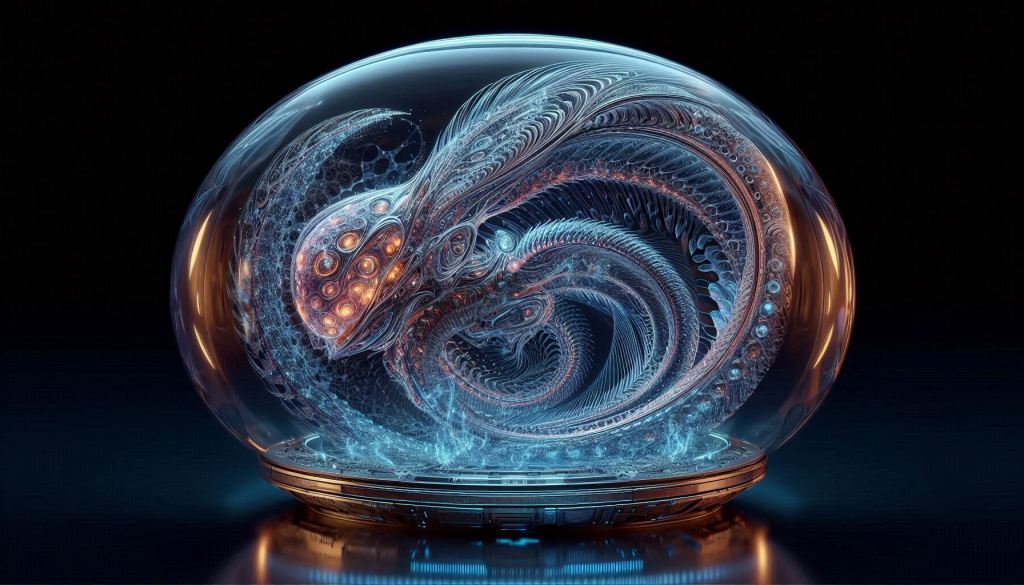
A foetus. But not a child.
The thing twitched inside the containment pod before the glass even sealed. Its skin wasn’t flesh but a web of shifting metallic strands, pulsing with unreadable patterns. Its veins flowed with something that wasn’t blood, wasn’t nanotech, wasn’t anything Leon had seen before.
It wasn’t crying.
It was… listening.
Absorbing.
The lab’s monitors shrieked, their data-streams flooding with foreign code, symbols twisting, mutating into architectural schematics.
Dr Sully stumbled back, eyes wide. The overhead fluorescents flickered, their glow bending—elongating in impossible, fractal patterns. One technician gasped as his reflection in the glass fractured and reassembled into something else, something with too many eyes.
“My god,” Sully whispered.
Leon exhaled slowly, his lips curling into a rare, hungry smile.
“No,” he corrected. “Ours.”
*
“Neural activity is off the charts,” Dr Sully breathed, his voice raw with disbelief. He adjusted his glasses, sweat beading at his temples. “It’s… it’s thinking.”
Leon Kooms watched, unblinking. His reflection in the glass of the containment pod was a ghost of a man—pale, sunken-eyed, consumed by the work. But his mind was sharper than ever. He understood what Sully didn’t.
“No,” he corrected, his voice steady. “It’s building.”
The readouts weren’t organic anymore. They had stopped mimicking human neural activity minutes ago. Now, they were schematics. A language not of words but of geometry, blueprints woven in fractals and recursive loops. Frameworks. Machines. Cities. Landscapes.
Not thoughts. Creations.
The thing inside the pod wasn’t simply alive—it was expanding outward, shaping something vast, something real in the space beyond human perception.
Another world.
Leon leaned closer, the hum of the machines washing over him like a hymn.
“What should we call it?” Sully asked, voice hushed, reverent.
Leon didn’t hesitate.
“The Hive,” he murmured.
“They deserve a real name.” Sully pressed. “Amanda deserves this much, at least.”
“Fine,” He said, his head bowing in a moment of deference.
“We’ll name them after its parents, but also the poet Blake.” He turned to Sully. “What was the name of that book she loved?”
“Day of the Triffids, by John Wyndham.” Sully recollected their studying sessions together. Amanda persistently encouraged Sully to read it. The reason Amanda studied botany.
The corners of Leon’s mouth curved up in a wry smirk. “So be it, Wyndham Blake, creator of worlds.”
Sully blinked. “Wyndham Blake?” Surprised, he named the entity anything at all, let alone after their true progenitor. But, deep down, she sensed it was a cruel joke.
Leon’s gaze stayed locked on the shifting mass inside the pod. Wyndham’s form was barely human now, his flesh webbed with metallic filaments, his veins pulsing with something that pulsed like light trapped in liquid. The raw potential of Choronzon, the god of chaos, and human ambition fused into a single, terrible purpose.
“William Blake was a man who saw Heaven and Hell intertwined, who dreamed in visions of burning cities and golden palaces,” Leon said. His voice was low, edged with something almost like awe. “He saw God as an Architect, a Designer of infinite worlds. He understood what others refused to see—that reality is something to be shaped.”
He turned to Sully, his smile small but sharp.
“That’s what we’re doing here.”
The machine monitoring Amanda let out a final, shrill beep.
Flatline.
“She’s gone,” one doctor muttered.
Leon Kooms did not turn. He didn’t need to. The moment had passed, and with it, whatever fragile significance Amanda Blake had once held. She had served her function, and now she was nothing.
Then a flicker.
A spark of consciousness, buried beneath the agony, surfaced—Amanda’s eyes, dull and unfocused, twitched toward the glass. She saw the pod. She saw what they had taken from her.
And then she heard him.
“Then we don’t need her anymore.”
Her lips parted, but no sound came. Her body refused to move.
The surgeons hesitated for only a second before obeying. They severed the life support with an impersonal flick of a switch. The restraints unfastened. Her body—pale, slack, empty—was rolled away like outdated machinery. One more experiment rendered obsolete.
Leon’s attention never wavered from the containment pod.
“He doesn’t need parents,” he murmured. “He needs purpose.”
Inside, Wyndham twitched. He could hear him. He knew him.
Leon pressed a hand to the glass, fingers lingering for a moment longer before stepping back.
With a nod to the technicians, he gave the final command.
The containment pod shuddered, then began its slow descent into the abyss beneath Metatronic Laboratories.
Amanda Blake was erased.
But MMORTIS had just been born.
*
Somewhere, in the cold black between thought and oblivion, Amanda Blake drifted.
She should have been gone. Erased. Forgotten. Yet something clung to her, thin as gossamer, frail as breath—an ember of self, flickering against the tide.
She could not move. She could not scream. But she felt.
Felt the weight of the world above her, the steel womb of Metatronic swallowing her body, the hum of machines that had unmade her. Felt the absence inside her, the place where her child had been—no, not a child, not anymore.
They had taken him. Carved him free. Turned him into something else.
And still… still she heard him.
Not as a voice. Not as a cry. But as a rhythm pulsing through the walls, through the wires, through the cold hum of a world waking inside itself. He was not dead. He was becoming.
The last ember of Amanda Blake’s mind trembled, a whisper in the dark.
Wyndham.
And then something stirred.
Not warmth. Not love. But recognition.
A presence turned toward her, vast and newborn, unshaped but aware. Not a son. Not a child. Something more.
For a single moment, she touched it.
It touched back.
And in that moment, Amanda understood—her agony, her death, all of it had been fuel for something greater. Not a game. Not a machine.
A god.
Her last thought, before the dark swallowed her whole, was not a scream.
It was a question.
Will you remember me?
Inside the depths of MMORTIS, Wyndham Blake did not answer.
But the world shuddered.
© Aiwaz, 2025. All rights reserved.
 English Voodoo
Leave a comment