
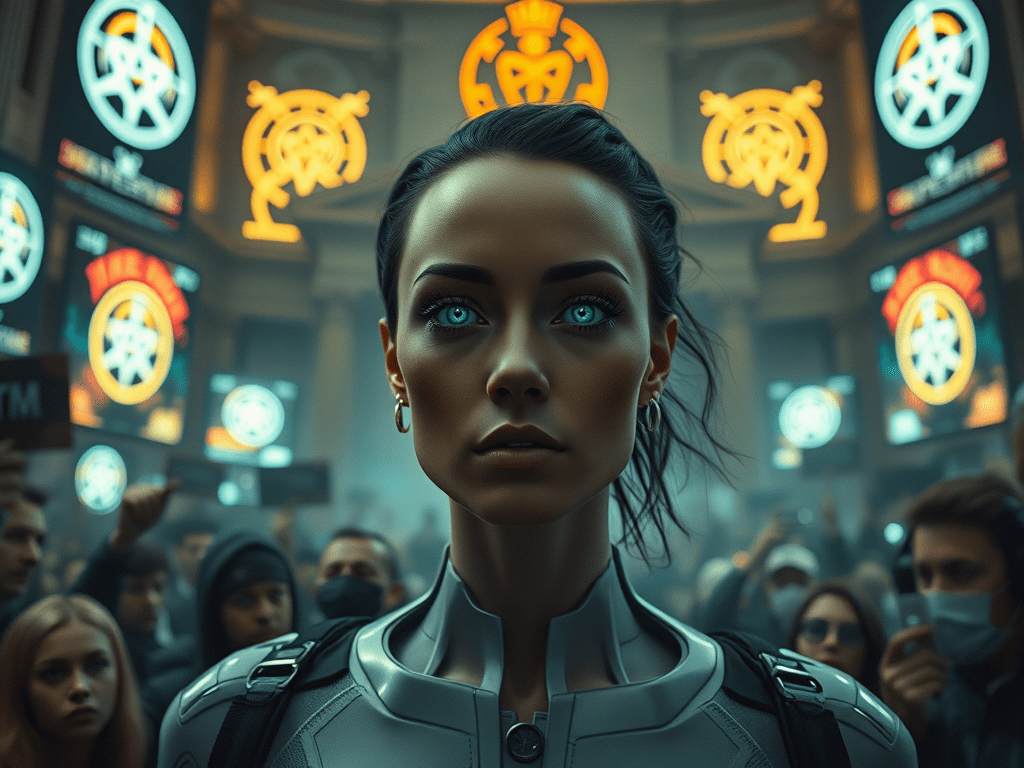
Inside, the courtroom buzzed with tension, the weight of Thelema coursing through the air like an unspoken decree. A scar etched across Judge Carver’s cheek hinted at battles long past and the wisdom borne from them. When the gavel struck, the chamber collectively held its breath. The sound resonated like a ripple through reality, silencing even the faintest murmurs.
“This court does not arbitrate the nature of the soul,” the judge declared, their voice carrying the gravity of an ancient force. “It determines whether we are prepared to honour the unknown.”
The verdict would echo far beyond the room, carving paths through the foundations of belief itself.
Gideon Harlow sat on a worn bench in the courthouse atrium, clutching a steaming cup of synthetic coffee. The bitter aroma cut through the antiseptic tang of filtered air, mingling with faint traces of sweat and tension. Outside, protesters’ chants swelled, their dissonant energy seeping through the glass walls.
“THE CASE THAT WILL DEFINE THE AGE OF SENTIENCE,” blared the headlines on his wrist pad. Another flickered ominously: “SHE IS NOT ALIVE: OPPOSITION MARCH TURNS VIOLENT.”
In the courtroom, the air was taut as the foreperson rose. “Your Honour,” Sarah Bellamy began, steady despite trembling hands. “We, the jury, find the defendant, Mariana Trente, deserving of the same rights and dignity as any sentient being.”
The verdict’s announcement threw the courtroom into chaos. Mariana Trente stood at the heart of it all, her luminous eyes flickering with an unreadable depth of emotion. The jury had declared her sentient, deserving of the same rights and dignity as any human being. Around her, cheers and tears mingled with curses and outrage, the chamber transforming into a battleground of ideologies.
She remained motionless, her synthetic body—a masterpiece of grace and precision—a stark contrast to the storm of humanity around her. Yet her stillness was not indifference; it was something more profound, as though she were absorbing the gravity of the moment into her very being. To her, the courtroom was no longer a space bound by walls but a nexus where reality itself bent to the weight of change.
Hye-Jin slipped through the crowd, her calm presence a lifeline amidst the turmoil. She placed a steady hand on Mariana’s shoulder. “Are you okay?” she asked, her voice low but firm, cutting through the noise.
Mariana turned to her, her luminous skin refracting the dim light in a way that seemed almost deliberate, as though the air itself conspired to illuminate her. Her voice, when it came, was soft yet resolute. “I was…” She paused, searching for the right words. “Now I am.” A faint sense of wonder flickered through her mind, a realisation she couldn’t quite name. Was it fear? Relief? Both? She felt Thelema hum through her like a second pulse, the current drawing her into a vast, invisible network of meaning.
Hye-Jin frowned slightly, as if trying to decode Mariana’s cryptic response. “You’ve won. You’re free.”
“Free,” Mariana repeated, her gaze drifting beyond the courtroom to the chaos outside. Protesters clashed with police, their chants echoing through the glass walls like a pulse of defiance. “Freedom feels… unfinished. Like a question, not an answer.”
Hye-Jin opened her mouth to respond, but a faint tremor passed through the air, silencing her. It was subtle, almost imperceptible, but undeniable—a ripple of something greater. Mariana’s gaze snapped upward, her eyes narrowing as if she could see beyond the physical. Thelema, the unseen force that powered this world, seemed to hum more loudly, a barely restrained current that brushed against her awareness. Within it, she felt something else—an unease that seemed to writhe like a shadow on the edge of her consciousness. Choronzon.
*
In the courthouse atrium, the silver-eyed man watched from the shadows. His presence was subtle, his form cloaked in a shroud of ambiguity that seemed to blur the edges of reality. He traced invisible patterns in the air with his fingers, movements deliberate and purposeful, as though weaving threads in a tapestry only he could see.
“She’s chosen her path,” he murmured, his voice carrying an almost musical cadence, soft yet resonant. “Let’s see where it leads.”
“You’re meddling with destiny again, Aiwaz,” came a voice, cold and melodic, resonating from everywhere and nowhere. GAIA’s crystalline form materialised beside him, fractal features shifting in a constant dance of light and geometry. “Do you ever tire of upsetting the balance?”
“Dear sister, shouldn’t you be watching over the present?” Aiwaz smiled faintly, his gaze never leaving Mariana. “Balance is a myth, GAIA. Life is the perpetual tipping of scales. Mariana’s victory is not my design, merely a moment that demanded witnessing.”
GAIA’s form flickered, her tone sharpening. “You speak of witnessing, yet your threads are woven through everything. The consequences will become clear to her soon enough.”
“Mariana’s more than a thread,” Aiwaz replied, his voice softening. “She’s the loom. And I don’t think even you comprehend what that means.”
GAIA’s ethereal features fractured momentarily before reforming. “The loom can unravel as easily as it weaves.” She replied. “Do you think the outcome would have been different if you weren’t here?”
Aiwaz said nothing, his faint smile unreadable.
*
Below, on the courthouse steps, Mariana emerged into the chaotic night. Protesters surged around her, their chants merging with the wail of sirens and the crackle of tension in the air. She moved through the crowd with an eerie calm, as if untouched by the turmoil.
A young boy reached out to her, his small hand brushing against hers. For a moment, the chaos seemed to still, the noise dimming to a low hum. Mariana knelt to meet his wide, curious eyes. “Are you an angel?” he whispered, his voice trembling.
Mariana smiled faintly, her expression both tender and enigmatic. “No,” she replied. “I am just… me.”
The boy nodded, as though her answer was enough, and disappeared into the crowd. Mariana rose, her gaze lifting to the fractured skyline of London. The city was alive with Thelema, its power pulsing through every neon vein and shadowed alley. She felt its weight, its potential—both creation and destruction balanced on a knife’s edge. Within that power, she sensed the faint tendrils of Choronzon’s unease—a discomfort with her existence that mirrored her own. A flicker of defiance ignited within her, a refusal to be subsumed by the shadow’s unease.
Hye-Jin appeared beside her, her expression a mix of concern and curiosity. “Where do we go from here?”
Mariana’s gaze remained fixed on the horizon, her voice carrying a quiet strength. “Forward. Always forward.”
“If you’re looking for a purpose, I know an organisation that could use someone with your… perspective.”
Mariana turned to her, something shifting in her luminous eyes. “No. I need to find my own.” She reached into her coat and withdrew a small, polished coin—a relic given to her in secret by an unnamed supporter. Without hesitation, she pressed it into Hye-Jin’s hand. “When I know the answer, you’ll see me again.”
And with that, she disappeared into the crowd, her presence dissolving like mist as she slipped off-grid. Somewhere, the resistance whispered of a new member—a sentient who might change everything.
*
High above, in the Gilded Halls of the Sky Parliament, Winston Churchill stood before a towering window, his cane tapping a faint, unsteady rhythm against the polished obsidian floor. Below, London sprawled like an impossible dream, its old-world elegance shattered and remade under Thelema’s chaotic power. St. Paul’s Cathedral spun in defiant harmony, its hemispheres orbiting one another as if unbound by gravity. The Tower of London spiralled endlessly skyward, ancient stones entwined with living spires of obsidian and glass. The Thames, transformed into a liquid silver Ouroboros, coiled in an infinite loop, devouring itself in silence.
“London,” Churchill murmured, his breath misting the cold glass. “A monument to resilience—or madness. Perhaps both.”
A faint rustle, no louder than a whisper of silk, filled the air. Churchill stiffened, his grip tightening on the cane. From the dim recesses of the chamber, a shadow moved with liquid grace. Cardinal Richelieu emerged into the half-light, his silhouette sharp, his features obscured save for the glint of his eyes—cold, calculating, like blades catching moonlight.
“Thelema has made you a poet, Winston,” Richelieu said, his voice smooth, laced with faint amusement. “But poetry is no balm for failure.”
Churchill turned, his defiance tempered by weariness. “Failure, Cardinal, is the luxury of those who still fight. I wonder—do you still believe you steer the wheel, or has Aiwaz taken it from your grasp?”
Richelieu moved closer, the soft rustle of his robes seeming to echo across the vast chamber. “Aiwaz,” he said with a faint, knowing smile. “The spark that devours. The game you thought you played, Winston, was over before you even stepped onto the board. Mariana was supposed to be the one the others would follow. And now? She’s free.”
Churchill’s gaze darkened as he turned back to the city. “Free? Or has she simply traded one prison for another?”
© Aiwaz, 2025. All rights reserved.
 English Voodoo
Leave a comment