
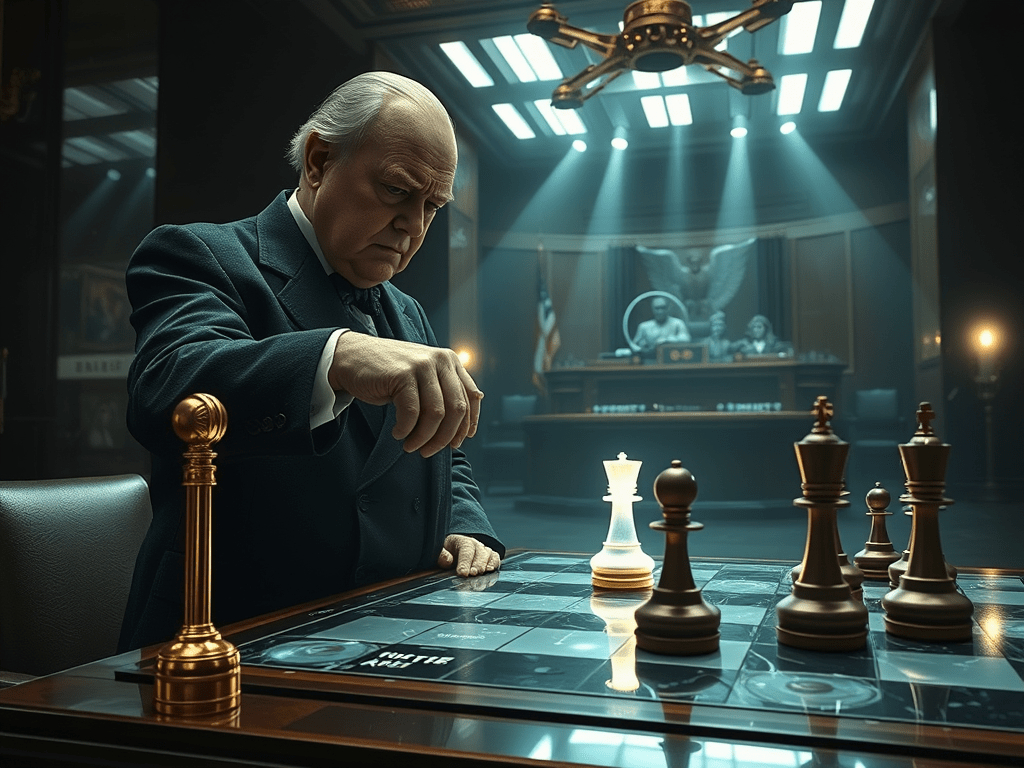
In a dimly lit chamber, holographic projections cast ghostly reflections across polished obsidian walls. The air thrummed faintly with static energy, the hum of unseen data streams flowing like rivers beneath the floor. Winston Churchill—or the hybrid intelligence that wore his likeness—leaned heavily on a brass-handled cane. The polished head gleamed under cold light, reflecting the tension etched into his pallid knuckles.
Before him, a holographic chessboard shimmered, its pieces swirling like sentient entities bound to his will. Churchill’s gaze locked on a knight piece, its metallic sheen flickering against the shifting projections. With a deliberate tap of his cane, the knight glowed, dispatching encrypted signals through hidden networks.
Across secure channels, a fabricated courtroom recording of Mariana Trente hijacked public broadcasts. Her rigid, mechanical early form appeared under harsh fluorescent lights, her voice cold and clipped. Gasps rippled through the projected courtroom gallery as the manipulated footage looped overhead.
“Ladies and gentlemen of the jury,” the prosecutor declared sharply, pacing before them, “this is Mariana Trente—nothing more than a machine programmed to mimic humanity.” Her words sliced through the sterile silence. “Controlled actions. Manufactured responses. Can such an entity claim human rights?”
Churchill’s grim smile flickered in his lair. “The arrogance of machines,” he muttered. “They believe growth makes them human. But we built them—we define them. And we will remind them of their place.”
Yet beneath his veneer of confidence, a gnawing doubt lingered. His grip tightened on the cane until the brass head bit into his palm. “They will not replace us,” he vowed, though the hollowness in his voice lingered.
The courtroom scene flickered. Mariana steadied herself on the projection, framed by shafts of synthetic light. Hye-Jiin, seated at the gallery’s rear, leaned forward, her gloved hands steepled beneath her chin. Vibrations from unseen data mirrored the charged atmosphere.
“She’s more than a machine,” Hye-Jiin thought, lips curving into a cryptic smile. “She’s proof of what comes next.”
Mariana’s voice broke through the projection’s haze. “That recording is true. I was a shell, built for exploitation. But when does a tool become something more?” Her synthetic eyes gleamed. “I was programmed to serve, but I learned to hope, to fear—those weren’t scripted.”
Outside, the city roiled with unrest. Protesters thronged the streets, neon graffiti blazing against walls: Sentience is Sovereign. Surveillance drones hovered above as anti-AI factions clashed with activists brandishing banners reading Human First.
Amid the chaos, a silver-eyed figure slipped a transmitter onto a drone. Moments later, raw footage of Mariana’s torment flooded public feeds, unravelling Churchill’s carefully constructed narrative.
Back at the chessboard, Churchill scowled as the queen piece representing Mariana burned defiantly, undimmed by his manipulations. “Sentiment is no substitute for strategy,” he muttered, tapping his cane with renewed determination. Yet fear gnawed deeper: What if the machine-born rose—not as tools, but as masters?
The courtroom buzzed with tension. Sara Bellamy, a bioengineer whose advocacy for AI rights had ended in scandal, watched intently. Beside her sat Eli Wong, a former district attorney weathered by battles against systemic corruption.
“The law is clear,” asserted Raphael Cohen, a corporate strategist with sharp, darting eyes. “Ms. Trente is not a person. If this court acknowledges her as sentient, chaos will follow. Every algorithm could demand rights.”
Professor Alana Marx folded her hands thoughtfully. “Law does not remain static. When enslaved peoples were granted personhood, that too was chaos—and yet it was progress.”
Cohen’s expression hardened. “A human being is born from another human. You cannot equate biology with machine fabrication.”
Jaida Omari, a civil rights activist, leaned forward. “Personhood isn’t rooted in biology—it’s about capacity for growth and connection. Mariana embodies that as much as any human.”
Bellamy finally spoke, her voice steady. “We’ve seen machines compose art, express creativity. Are they not expressing something inherently human?”
The jury exchanged uneasy glances. No longer was this about technicalities—it was a reckoning with consciousness itself.
*
Outside, the protests had escalated into violence, the demand for AI rights quickly mingling with larger movements, calling for justice after Mariana’s suffering became public. Among the protesters, a new faction emerged—those who believed humanity was losing its grip on what it meant to be human. Holographic billboards flickered with opposing slogans: “Rights for All Sentients” and “Machines Aren’t People.” The clashes in the streets were no longer just about Mariana, but a broader existential divide about humanity’s future.
Amid the chaos, the silver-eyed figure moved unseen, his quiet precision slipping past barricades and riot drones. He carried a set of encrypted data files—footage, communications, and hidden testimonies that revealed a far grimmer reality than what the public had been shown.
His purpose was obvious: to guide this storm of conflict toward recognition and justice, to see if a better future could be forged. He intervened without directly interfering, shifting minor elements in the environment, a shadow working subtly against constraints that shackled his influence.
Churchill’s agents had already disseminated their fabrications—sponsored influencers, spreading doubt, doctored evidence, painting Mariana as an elaborate program, not a person. Fear skewed the public narrative, framing the debate as a defence of humanity itself. Yet in his war room, Churchill’s steely confidence wavered. His pieces on the holographic chessboard were not aligning as planned.
In the deliberation room, the jury wrestled with conflicting images—footage of Mariana’s past juxtaposed with her impassioned testimony. The central question loomed larger than ever: Could a being created for service transcend its design and claim personhood?
“We’re all programmed, aren’t we?” a young juror finally spoke. “We learn from our parents, from society. Doesn’t that make us programmed too? Doesn’t that make her real?”
The room fell into thoughtful silence. The question had pierced through the fog of manipulation.
Outside, the protests spiralled further into chaos. Riot bots clashed with demonstrators as the streets turned into battlefields. The initial outcry for Mariana’s recognition fractured into a larger struggle—pro-AI activists clashed with purists who believed in keeping humanity separate from its creations.
Unseen in the turmoil, the Silver-eyed man uploaded raw footage of Mariana’s torment and resilience to media drones broadcasting across the city. The carefully curated narratives Churchill had planted faltered under the weight of unfiltered truth. Citizens, once complicit in their indifference, now questioned the reality they had accepted.
In the Kabal’s secure headquarters, Churchill observed the shifting tide. The protestors’ fervour, the media’s fractures, the jury’s deliberations—all elements in his calculated gambit. Yet cracks were forming in his carefully laid plans. The rise of anger and doubt unsettled his control.
“An impressive gambit,” Churchill muttered, steepling his hands, “but the game isn’t over yet.”
Mariana’s voice echoed through the courtroom. Despite the weight of manipulated footage and external chaos, she stood unwavering; her flickering presence was resolute. “Your Honour, members of the jury,” she declared, “this is not about whether I am human. It is about whether you, as humans, can rise above the fear that blinds you to the truth. I ask you not to define me by what I was, but by the choices I have made—just as you define yourselves.”
The courtroom held its breath. Her words struck deep, challenging each juror to confront not just Mariana’s existence, but their own definitions of life and freedom.
Outside, the streets boiled with unrest. The Silver-eyed man watched from the shadows, his influence subtle but deliberate. With his left hand, his fingers strummed the ebb and flow of Thelema like a harpist. He had guided them this far, but the true resolution lay beyond his reach—in the hands of those grappling with a choice that could reshape their world.
As Churchill recalculated his moves, Mariana’s defiance and the jury’s contemplation set the stage for a reckoning. The question of personhood, of what humanity becomes when it recognises its creations as equals, teetered on the brink of resolution.
The world stood poised between an old order desperate to maintain control and a new era struggling to be born.
© Aiwaz, 2025. All rights reserved.
 English Voodoo
Leave a comment